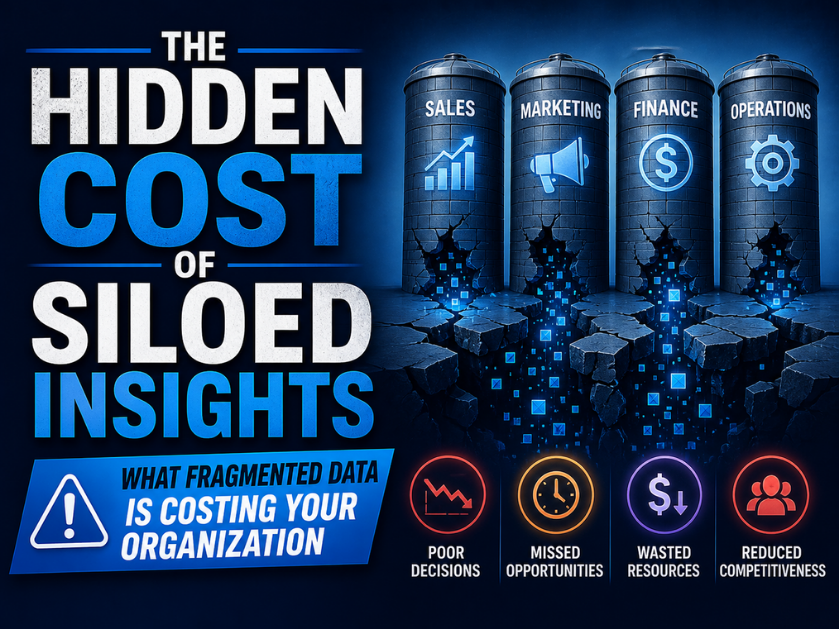
Siloed data insights cost organizations clarity, alignment, and better business decisions across the enterprise.
There is a particular kind of organizational frustration that enterprise leaders know well. You have invested heavily in research. Your analytics team is producing dashboards. Your market research function is running studies. And yet when it is time to make a critical strategic decision no one can quite agree on what the data says.
That frustration has a name: siloed insights. And it is costing your organization far more than most leadership teams realize.
The cost of fragmented customer data is not always visible on a balance sheet. It shows up in slower decisions, misaligned strategies, redundant research spending, and missed market opportunities. It shows up when a product launches without the customer intelligence that the insights team actually had. It shows up when a competitor makes a move your organization could have anticipated but did not because no one was synthesizing signals across functions.
This article examines the real and measurable cost of siloed insights in enterprise organizations, identifies the warning signs that your intelligence function is more fragmented than you may realize, and outlines what it takes to build a unified intelligence capability that actually reaches the people making your most important decisions.
What Are Insight Silos and How Do They Form?
An insight silo exists whenever valuable customer, market, or operational intelligence is controlled by one team, system, or department and does not flow to the rest of the organization in a useful and timely way.
Insight silos are rarely intentional. They form naturally as enterprise organizations grow. A customer insights team develops expertise in survey research and qualitative studies. A separate data science team owns behavioral analytics and modeling. A competitive intelligence function monitors the external landscape. A finance team tracks revenue and cost data. Each team does good work. Each team speaks a different data language. And none of their outputs is systematically connected into a coherent picture that the whole organization can act on.
The result is an organization where intelligence exists in abundance but arrives in fragments. Individual teams have narrow and deep visibility into their own domain. Leadership has a broad but shallow view that misses the synthesis necessary for genuinely confident strategic decisions.
|
Insight silos do not mean your teams are failing. They mean your organization has not yet built the infrastructure to connect the excellent work those teams are doing into unified decision grade intelligence.
|
The Real Cost of Fragmented Customer Data
When organizations audit the true cost of siloed insights the numbers are rarely comfortable. The costs are distributed across multiple categories which is part of why they remain invisible for so long.
Wasted Research Investment
When insight functions operate in silos duplicated research is common. The marketing team commissions a customer segmentation study. Six months later the product team commissions a remarkably similar one. Neither team knew the other had already answered most of the same questions. At enterprise scale this kind of redundant research spending adds up to significant wasted budget every year.
Slower Decision Cycles
When leadership needs intelligence to support a strategic decision and that intelligence is scattered across three teams in three different formats, someone has to manually compile and reconcile it before the decision meeting can proceed. That process takes time. In fast moving markets time is competitive advantage and organizations whose decisions lag behind their competitors pay a compounding cost for it.
Decisions Made Without the Best Available Intelligence
Perhaps the most consequential cost is the one that is hardest to measure: the decisions that were made without access to insight that already existed somewhere in the organization. A product roadmap decision made without the customer research sitting in the insights team. A pricing decision made without the competitive intelligence the strategy team had already gathered. A market entry decision made without the behavioral data the analytics team could have provided.
These are not hypothetical scenarios. They are the daily reality of enterprise organizations that have not yet unified their intelligence function.
Erosion of Executive Confidence in Data
When leadership repeatedly receives conflicting numbers, inconsistent findings, or intelligence that arrives too late to be useful they stop trusting the data function. When that happens decisions revert to intuition and political influence rather than evidence. This is the deepest and most damaging long term cost of fragmented insights: the erosion of organizational confidence in data driven decision making itself.
|
IDC research has estimated that poor data quality alone costs organizations an average of 15 to 25 percent of their revenue. Fragmented insight delivery compounds that cost by ensuring that even high quality data fails to reach the decisions that need it most.
|
A Breakdown of Common Silo Types and Their Business Cost
Not all insight silos are created equal. The table below maps the most common silo types in enterprise organizations to the specific business costs they generate.
|
Silo Type
|
What Gets Missed
|
Business Cost
|
|
Customer Research Silo
|
Customer needs are known only to the insights team
|
Product teams build features customers do not want
|
|
Analytics Silo
|
Behavioral patterns locked inside the data science function
|
Marketing and sales act on instinct instead of evidence
|
|
Competitive Intelligence Silo
|
Competitor moves visible only to the strategy team
|
Leadership is blindsided by market shifts
|
|
Financial Data Silo
|
Revenue and cost trends siloed inside finance
|
Growth investments are made without profitability context
|
|
Operational Data Silo
|
Fulfillment and service data isolated from customer teams
|
Customer experience decisions ignore real operational constraints
|
What this table illustrates is that every silo type generates costs in a specific part of the organization. When multiple silos exist simultaneously across an enterprise those costs compound. And they do so quietly because no single failure is dramatic enough to trigger an immediate response. The organization simply moves more slowly, spends more, and decides with less confidence than it should.
Warning Signs That Your Insight Function Is More Fragmented Than You Think
Many enterprise organizations do not fully appreciate the extent of their insight fragmentation because the signs are normalized over time. The following diagnostic table is designed to surface those signs and reframe what they actually signal.
|
Warning Sign
|
What It Actually Signals
|
|
Different teams report different numbers for the same metric
|
No single source of truth exists across the organization
|
|
Research findings circulate via email and slide decks only
|
Insights are not embedded into any operational system or workflow
|
|
Leaders request the same data repeatedly without getting it
|
Insight delivery is reactive rather than systematically available
|
|
Decisions get made before research is complete
|
The insights function is not integrated into the decision cycle
|
|
High-quality research sits unused after delivery
|
There is no structured process for translating insight into action
|
If three or more of these warning signs are present in your organization your insight function is likely operating well below its strategic potential. Not because your teams are underperforming but because the architecture connecting them does not exist yet.
The Strategic Cost Is Larger Than the Operational Cost
It is tempting to frame the cost of siloed insights as a purely operational problem. Wasted research budget, duplicated effort, slow report delivery. These are real costs and they matter. But the more important conversation is about strategic cost.
Strategic cost is what happens when fragmented data produces fragmented decisions. When a company misreads a market because no one connected the customer sentiment data to the competitive intelligence. When a product investment is made on incomplete evidence because the relevant behavioral data existed in a different team. When a leadership team enters a planning cycle with confidence that turns out to be based on a partial view of reality.
At enterprise scale one strategic miscalculation built on fragmented intelligence can cost more than years of wasted research budget. The return on investment of integrated insight is not measured in research efficiency. It is measured in the quality of the decisions it enables.
|
Organizations that have unified their intelligence functions consistently report two things: faster decisions and more confident ones. Both have a direct and measurable impact on competitive performance.
|
What Unified Intelligence Actually Looks Like
Fixing siloed insights is not primarily a technology problem. It is an organizational architecture problem. The organizations that have solved it share several common structural characteristics.
A Single Intelligence Function With Cross Domain Visibility
The most effective enterprise intelligence structures position a central insights function with visibility across customer research, behavioral analytics, market intelligence, and competitive monitoring. This team’s job is not to do all the research. It is to synthesize across all sources and deliver a unified and coherent intelligence view to leadership.
Shared Definitions and a Single Source of Truth
When different teams define customer segments, satisfaction metrics, or market size differently, there is no basis for coherent synthesis. Unified intelligence requires shared definitions, common metrics, and a data governance framework that enforces consistency across functions.
Structured Intelligence Delivery to Decision Makers
Intelligence that lives in a database or a shared drive is not being used. Effective unified intelligence functions deliver structured and curated briefings to executive and leadership audiences on a regular cadence, proactively connecting the dots across data sources rather than waiting for leaders to pull information themselves.
Integration Into Decision Workflows
The final and most critical structural element is that intelligence delivery is embedded into the workflows where decisions actually happen. Strategy planning cycles. Investment committee reviews. Quarterly business reviews. When intelligence arrives at the table where decisions are being made rather than sitting in a team repository the value of the insight function multiplies.
Five Steps to Begin Dismantling Insight Silos in Your Organization
- Conduct an insight audit. Map every source of customer, market, and operational intelligence that exists across your organization. Identify who owns it, where it lives, and how it currently reaches decision makers. The audit alone will surface opportunities that were previously invisible.
- Identify the highest cost silos first. Not all fragmentation is equally damaging. Prioritize integration efforts around the insight sources that most directly affect your most important strategic decisions.
- Establish shared metrics and common definitions. Before you can synthesize across sources, you need shared definitions. Agree on how key metrics are defined and measured across teams.
- Create a central synthesis function. Designate a team or individual responsible for connecting insights across sources and delivering a unified view to leadership. This does not require a large team. It requires a clear mandate and executive sponsorship.
- Embed intelligence into decision workflows. Work backwards from the decisions that matter most. Identify where in those decision workflows integrated intelligence would be most valuable and build the delivery mechanisms that put it there.
The Organizations That Win Are the Ones That Connect the Dots
The enterprise organizations that consistently make better decisions are not necessarily the ones with more data. They are the ones that have built the organizational infrastructure to connect their data into a unified intelligence view that leadership can actually use.
Siloed insights are not a sign that your teams are failing. They are a sign that the architecture connecting those teams has not kept pace with the complexity of your organization. Building that architecture is one of the highest return investments an enterprise can make.
The cost of fragmented customer data is real, it is large, and most of it is invisible until you go looking for it. When you do find it you will also find that fixing it is more achievable than it appears.
|
At Mack Turner Marketing we help enterprise organizations identify the true cost of fragmented intelligence and build the integrated insight systems that enable leadership to make faster and more confident decisions. If you are ready to close the gaps in your insight architecture we would welcome that conversation.
|
Frequently Asked Questions
Q1: What exactly is a data silo in an enterprise context?
A data silo is any situation where information is controlled or accessible by only one team, system, or department and is not shared across the organization. Silos are not always intentional. They often emerge naturally as organizations grow, add tools, and develop specialized functions. The problem is not that specialized teams exist. It is that the intelligence they hold never gets synthesized into a unified view that the whole organization can act on.
Q2: How much does fragmented data actually cost an organization?
The direct financial cost is difficult to isolate, but research consistently points to significant waste. IDC has estimated that data quality and fragmentation issues cost organizations hundreds of billions of dollars annually in lost productivity, poor decisions, and missed opportunities. The indirect costs are arguably larger: slower decisions, misaligned strategies, and missed market signals that competitors capitalize on first.
Q3: Is data fragmentation more of a technology problem or a people problem?
It is primarily an organizational and governance problem that technology often amplifies. The tools that create silos are usually tools that were deployed to solve a specific problem without consideration for how their data would connect to other systems. Solving it requires organizational structure changes, governance decisions, and leadership alignment as much as technical solutions.
Q4: What is the first step toward breaking down insight silos?
The most effective starting point is an insight audit: a structured assessment of what customer, market, and operational data exists across the organization, where it lives, who owns it, and how it currently reaches decision makers. This audit almost always reveals both the extent of the fragmentation and the highest value opportunities for integration.
Q5: Can a company fix siloed insights without replacing its entire technology stack?
Yes. While modernizing data infrastructure helps, many of the most impactful improvements come from organizational and process changes rather than technology replacement. Establishing a unified insight function, creating structured synthesis processes, and building shared intelligence briefings can dramatically reduce the impact of silos without requiring a full technology overhaul.
Q6: How do integrated insight systems improve executive decision making specifically?
When leadership has access to a unified view that connects customer research, market intelligence, behavioral analytics, and financial data, two things happen. First, the quality of decisions improves because they are grounded in a more complete picture. Second, the speed of decisions improves because leadership is not waiting for different teams to compile and reconcile conflicting data before a meeting can proceed.