

Enterprise Decision Intelligence: Why Organizations Need Coherence, Not More Data
More data does not guarantee better decisions. Learn why enterprise decision intelligence helps organizations create clarity, alignment, and strategic action.
Welcome to WordPress. This is your first post. Edit or delete it, then start writing!

May, 2026
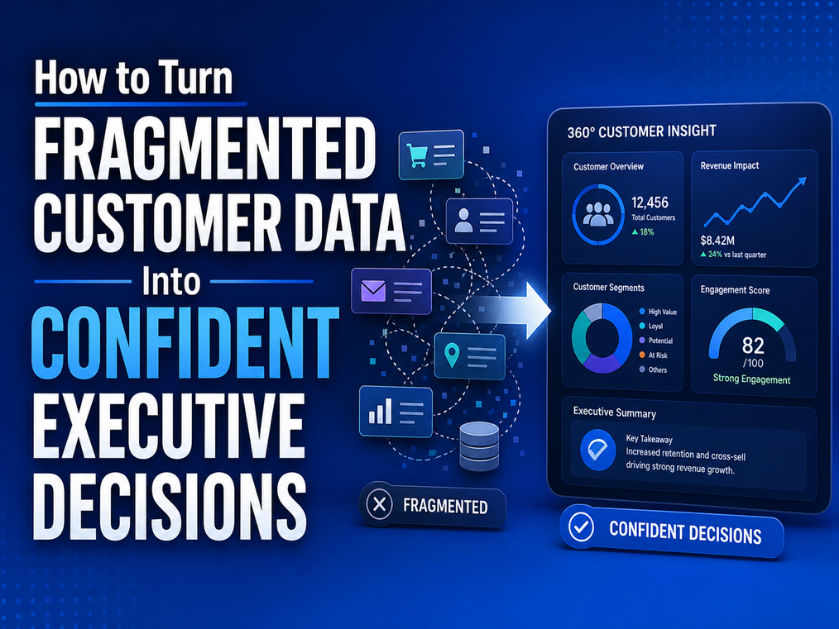
Picture this. A leadership team walks into a strategy meeting to decide whether to expand into a new market segment. The head of research presents a customer needs study. The analytics team shares a behavioral data report. The competitive intelligence lead adds a market landscape summary.
Three teams. Three documents. Three different versions of what the customer looks like.
By the end of the meeting, no one has made a decision. Another follow-up has been scheduled. Another month has passed.
This scenario plays out inside enterprise organizations every single day, and it is not a data problem. Organizations have plenty of data. It is a customer data decision making problem. The data exists. It just never gets synthesized into the kind of clear, confident intelligence that leadership teams actually need to move forward.
|
74% of executives say data doesn’t reach them in a usable form |
3x faster decisions in organizations with unified insight systems |
These numbers point to the same truth. The gap between data and decisions is not a technology gap. It is a structure and synthesis gap.
There is a common assumption that if an organization just collects enough data, better decisions will naturally follow. In practice, that is rarely how it works.
More data without a clear structure for synthesizing it creates more noise, not more clarity. Leaders end up with longer reports, more dashboards, and bigger data teams, but the same frustrating lack of confidence when it matters most.
|
The organizations that make the best decisions are not the ones with the most data. They are the ones with the clearest path from data to a decision. |
The path from raw customer data to a confident executive decision requires three things that most organizations have never deliberately built: integration, synthesis, and decision orientation. We will walk through each one.
Customer data lives in a lot of places inside a large organization. Survey platforms hold voice of customer research. CRM systems hold transaction and engagement history. Digital analytics tools track behavioral patterns. Market research vendors deliver quarterly studies. Competitive intelligence reports sit in email inboxes.
None of this information is wrong on its own. The problem is that each source only tells part of the story. And when decision makers need a complete picture, they have to manually piece together reports from five different teams in five different formats, often with five different definitions of what a customer segment even means.
Integration means deliberately connecting these sources so that they can be analyzed together. This does not necessarily require a single giant database or an expensive new platform. It requires an architecture, a thoughtful design for how data flows between sources and how it gets routed to the people who need it.
Integration gets the data in the same room. Synthesis is what turns it into intelligence.
Synthesis means taking multiple data streams and interpreting them together to produce a finding that none of them could produce alone. A customer satisfaction score goes up. Behavioral data shows purchase frequency is declining. A qualitative study reveals that customers love the product but find the renewal process confusing. Synthesized together, those three signals tell a specific story that drives a specific action.
Most organizations are reasonably good at collecting and even integrating data. Very few are good at synthesis. It requires analytical skill, strategic context, and a clear understanding of the decision the intelligence is meant to support.
|
Raw data tells you what happened. Synthesized intelligence tells you what to do about it. |
This is the most overlooked layer and often the most important one.
Even well-integrated and well-synthesized intelligence fails to drive confident decisions if it is not formatted and delivered in a way that connects directly to the question leadership is trying to answer.
Decision orientation means designing every piece of intelligence output backward from the specific decision it needs to support. Not backward from the data that is available. Not forward from what the research team finds interesting. Backward from the decision.
When this discipline is applied consistently, something powerful happens. Leadership teams stop saying things like ‘we need more data before we can decide.’ The intelligence they receive is built to answer their actual question, not to document what the research team discovered.
|
Reactive Insights |
Decision-Grade Intelligence |
|
|
Starting point |
Available data |
The decision to be made |
|
Delivery format |
Reports and dashboards |
Synthesized strategic briefings |
|
Timing |
After leadership asks for it |
Before the decision point arrives |
|
Output |
Information for review |
Recommended action with evidence |
|
Confidence level |
Leaders still feel uncertain |
Leaders move forward with clarity |
|
Strategic role |
Insight as a reporting function |
Insight as a strategic asset |
The organizations on the right side of this table are not smarter or better resourced than the ones on the left. They have simply made a deliberate choice to design their insight function around decisions rather than around data production.
If your organization is stuck on the left side of that table, the good news is that the path forward does not require a massive technology overhaul or a complete reorganization. It requires a shift in how you think about the purpose of your insight function.
Here is a practical framework to get started.
When customer data decision making is working well, the experience for leadership feels noticeably different. Meetings move faster because the intelligence coming in is already synthesized and formatted around the question being discussed. Disagreements about the facts become rare because everyone is working from the same unified source of customer truth.
Leaders start making bigger, bolder strategic moves because they trust the intelligence supporting those moves. The insight function stops being seen as a support group and starts being treated as a strategic partner.
|
When insights are built around decisions, leadership teams stop asking for more data and start making more confident calls. |
The research team at one Fortune 100 financial services firm described the change this way after redesigning their insight architecture. Before the change, they spent about sixty percent of their time producing recurring reports that leadership skimmed. After the change, nearly all of their work was tied directly to a strategic decision already on the executive agenda. The reports got shorter. The impact got larger.
Customer data decision making is one of the most powerful competitive advantages available to enterprise organizations today. It is also one of the most consistently underdeveloped.
The organizations that close the gap between their data and their decisions do not do it by buying more technology or hiring more analysts. They do it by redesigning the purpose, structure, and delivery of their insight function around the decisions that matter most.
If your leadership team is still walking out of strategy meetings with more questions than answers, the solution is not more data. It is a smarter path from the data you already have to the decisions you need to make.
That path starts with a clear question: are your insights designed to inform decisions, or just to document findings? The answer to that question determines almost everything else.
More data does not guarantee better decisions. Learn why enterprise decision intelligence helps organizations create clarity, alignment, and strategic action.