|
The quality of a decision is not measured by the outcome. It is measured by the process used to make it.
A foundational principle of decision science
|
There is a version of decision making that most business leaders are familiar with. A question arises. People gather. Everyone shares their perspective. Someone with enough authority makes a call. The meeting ends.
That process has carried organizations for decades. But at the scale and complexity of a Fortune 500 enterprise, where a single strategic misstep can cost hundreds of millions of dollars, that kind of informal decision making carries enormous risk.
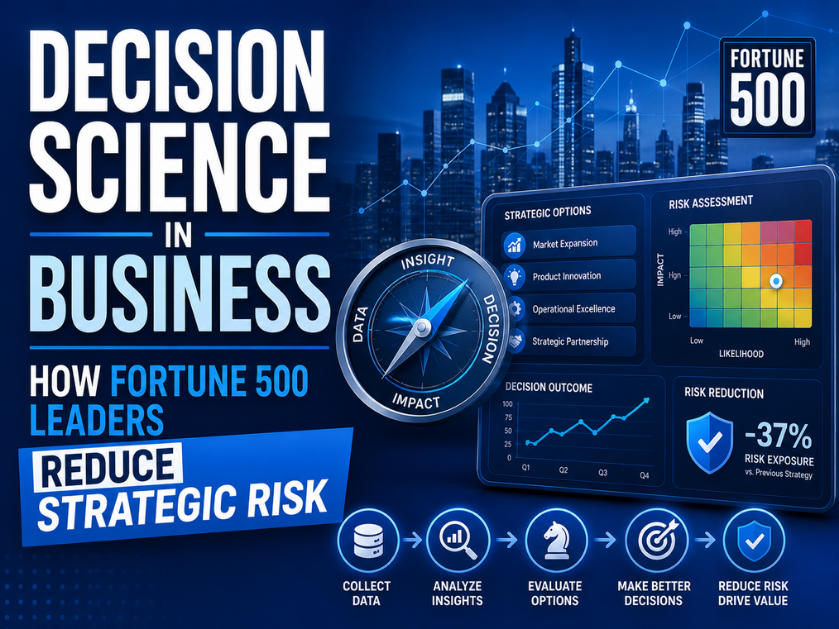
Decision science in business offers something fundamentally different. It is a disciplined, evidence-based approach to structuring how high-stakes decisions get made so that the quality of the process is as strong as the quality of the outcome it produces.
This post explains what decision science actually is inside a large organization, how Fortune 500 leaders use it to reduce strategic risk, and what it takes to build decision science capabilities that stick.
What Decision Science Actually Means in a Business Context
Decision science is the structured application of analytical thinking, behavioral insight, and evidence-based frameworks to improve how organizations make choices. It draws from economics, psychology, statistics, and organizational behavior to design better decision processes rather than just better analyses.
In practice, decision science inside a large business means three things working together.
- Structured framing: Defining the decision clearly before gathering any data. What exactly are we deciding? What are the realistic alternatives? What would we need to believe to choose each one?
- Evidence synthesis: Pulling together the right quantitative and qualitative intelligence and interpreting it specifically in the context of the decision being made, not just reporting what the data shows.
- Process discipline: Designing the decision-making process itself so that cognitive biases, political pressures, and incomplete information are accounted for and managed rather than allowed to quietly distort the outcome.
|
Decision science does not replace executive judgment. It gives that judgment a stronger foundation to stand on.
|
Why Strategic Risk Is Higher Than Most Leaders Realize
Research in organizational behavior consistently shows that even highly experienced executives are susceptible to a small set of predictable decision-making traps. These are not signs of poor leadership. They are deeply human patterns that emerge under the exact conditions that senior leaders face most often: time pressure, high stakes, incomplete information, and strong opinions from credible colleagues.
|
EXPERT PERSPECTIVE: On cognitive bias in executive decisions
|
|
The most dangerous biases in strategic decision making are not the obvious ones. They are the ones that feel like good judgment. Confidence that is calibrated to past success. Pattern recognition that is applied to situations that look familiar but are actually different. Consensus that forms around the most senior voice in the room rather than the strongest evidence. These patterns are extremely difficult to see from the inside, which is exactly why structured decision frameworks exist.
|
The five risk patterns that appear most often in enterprise decisions
- Confirmation pull. Teams naturally gather evidence that supports the direction leadership already prefers. Contradictory signals get underweighted, explained away, or simply never surfaced.
- Sunk cost pressure. The more an organization has already invested in a direction, the harder it becomes to objectively evaluate whether continuing makes sense. Past spending shapes future choices in ways that pure logic would not endorse.
- Overconfidence in analogies. Leaders who have successfully navigated similar situations in the past often apply those mental models to new situations that appear similar but carry meaningfully different dynamics.
- Authority convergence. In hierarchical organizations, the most senior perspective tends to anchor the group’s thinking early in the process. Others calibrate their views to what they believe leadership wants to hear rather than what the evidence actually supports.
- Urgency compression. When decisions feel urgent, the deliberation process shortens, alternatives narrow, and the range of evidence considered shrinks. Many of the most costly strategic mistakes happen not because leaders made the wrong choice but because they made a reasonable choice without enough time to examine it properly.
The Four Levels of Decision-Making Maturity in Enterprise Organizations
Most large organizations sit somewhere on a spectrum between purely intuitive decision making and fully evidence-driven, process-disciplined decision science. Understanding where you are helps clarify what to build next.
|
Level 1
Intuitive
Decisions made on experience and authority. Little structured process.
|
Level 2
Informed
Data presented in meetings but not synthesized around the decision.
|
Level 3
Structured
Defined frameworks used for major decisions. Some cross-team alignment.
|
Level 4
Systematic
Decision science embedded enterprise-wide. Proactive, bias-aware, evidence-led.
|
Most Fortune 500 organizations operate between Level 2 and Level 3. The organizations that have deliberately invested in reaching Level 4 show measurably different outcomes in decision speed, leadership alignment, and strategic accuracy.
How Fortune 500 Leaders Actually Apply Decision Science
Decision science at the Fortune 500 level is not a single tool or methodology. It is a set of practices that get applied selectively to the decisions that carry the most strategic weight. Here is how it tends to show up in practice.
Pre-decision framing sessions
Before any data is gathered or analysis commissioned, the most sophisticated decision teams hold a structured framing session. The goal is to precisely define what decision is actually being made, what the realistic alternatives are, what success looks like across a two to five year horizon, and what the most important unknowns are.
This step sounds simple. In practice it is surprisingly rare and surprisingly valuable. Many expensive analyses get built in service of the wrong question because no one spent an hour getting the question right first.
Structured alternative generation
One of the consistent findings in decision science research is that most decision teams generate too few alternatives too early and then spend most of their energy evaluating those limited options rather than exploring whether better ones exist.
Fortune 500 organizations that apply decision science deliberately widen the option set before narrowing it. They use techniques like pre-mortem analysis, red team challenges, and outside perspective reviews to surface alternatives that internal groupthink tends to suppress.
Evidence weighting and synthesis
Not all evidence is equal. Decision science frameworks help leadership teams explicitly weigh the reliability, recency, and relevance of different evidence sources rather than treating all inputs as equally credible.
This is where integrated customer intelligence and enterprise insight systems play a critical role. When organizations have a unified, decision-grade intelligence layer already in place, evidence synthesis becomes dramatically faster and more reliable.
Bias checkpoints built into the process
The most mature decision science programs include explicit checkpoints designed to surface and challenge the cognitive biases most likely to distort a particular type of decision. Before a major market entry decision, for example, the team might run a structured challenge specifically focused on overconfidence and sunk cost pressure. Before a major acquisition, the focus might shift to anchoring bias and authority convergence.
|
The value of a bias checkpoint is not that it eliminates bias. It is that it creates a moment where the team is explicitly invited to question whether the direction they are heading is being driven by evidence or by something more human.
|
What Organizations Risk Without Decision Science vs. What They Gain With It
|
Without decision science
|
|
With decision science
|
|
• Costly strategic mistakes driven by confirmation bias
• Slow decisions because leaders cannot agree on the facts
• Inconsistent outcomes from high-stakes investments
• Low confidence in major calls despite large amounts of data
• Cross-functional misalignment on strategic priorities
• Post-decision regret when overlooked evidence surfaces late
|
|
• Structured process that surfaces and challenges key assumptions
• Faster alignment because evidence is synthesized around the decision
• More consistent outcomes from disciplined investment decisions
• Higher executive confidence backed by rigorous evidence frameworks
• Enterprise-wide alignment through shared analytical standards
• Fewer surprises because the full range of risk is examined early
|
Building Decision Science Capability Inside Your Organization
Decision science does not get built overnight, and it does not happen through a single training program or a new software platform. It grows through a combination of process design, cultural shift, and consistent practice applied to real decisions over time.
Here is where the most effective organizations start.
- Start with your most consequential decision type. Pick one category of high-stakes decisions that your organization makes repeatedly and apply a structured decision science framework to it deliberately. Prove the value in that context before trying to scale the approach enterprise-wide.
- Build a shared decision vocabulary. Give your leadership team a common language for talking about decisions, alternatives, evidence quality, and risk. Organizations that share this vocabulary make alignment dramatically faster because everyone is operating from the same mental model.
- Invest in integrated intelligence as the foundation. Decision science without quality intelligence inputs is structure without substance. Building a unified customer and market intelligence capability is the single most important precondition for decision science to work at scale.
- Design bias checkpoints into the process. Do not rely on individual leaders to self-correct for cognitive bias. Build the checkpoints into the formal process so that bias examination is a structural feature of how major decisions get made, not an optional add-on.
- Measure decision quality, not just decision outcomes. Outcome measurement alone creates perverse incentives and misleading learning. Track the quality of the decision process itself alongside outcomes. Over time, high-quality processes produce better results on average even when individual outcomes vary.
The Long View on Decision Science
The organizations that invest seriously in decision science do not do it because they distrust their leaders. They do it because they respect the complexity of the environment those leaders operate in and they want to give them every possible structural advantage.
At the Fortune 500 level, the gap between a well-made decision and a poorly made one can easily measure in hundreds of millions of dollars of enterprise value. Decision science does not guarantee perfect outcomes. Nothing does. But it meaningfully and measurably improves the reliability of the process that produces those outcomes.
That reliability compounds over time. Organizations that make consistently better decisions year after year do not just avoid costly mistakes. They build a strategic capability that becomes a source of durable competitive advantage in its own right.
If your organization is serious about reducing strategic risk, improving leadership alignment, and turning your data investments into better decisions, decision science is not a luxury. It is infrastructure.