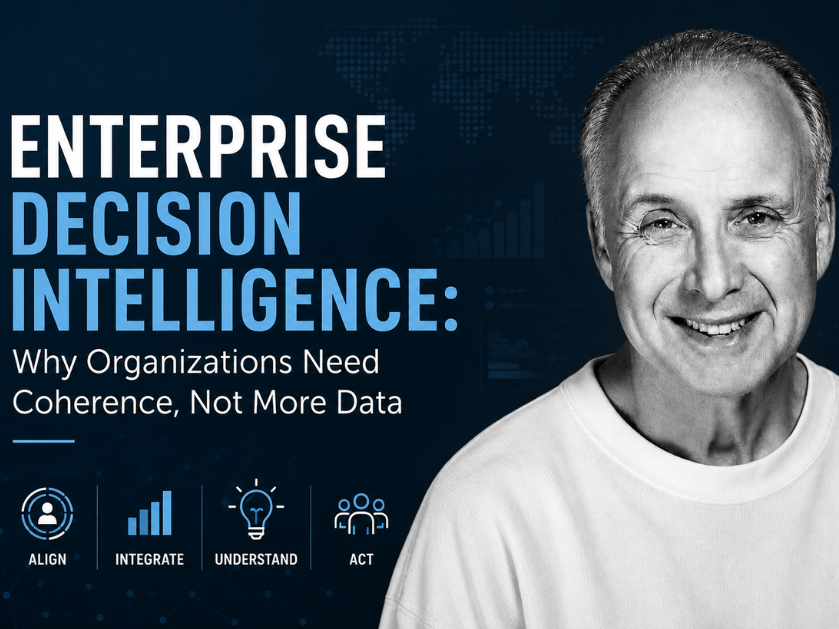



Enterprise Decision Intelligence: Why Organizations Need Coherence, Not More Data
More data does not guarantee better decisions. Learn why enterprise decision intelligence helps organizations create clarity, alignment, and strategic action.
Welcome to WordPress. This is your first post. Edit or delete it, then start writing!
August, 2026
Listening is not a strategy. If nothing happens after an organization listens, people eventually stop talking.
Most companies have become remarkably good at gathering signals:
Customer feedback. Employee surveys. Social listening. Market research. Competitive intelligence. Operational data. AI-generated analysis.
The problem is rarely a lack of information.
It is what happens next.
A customer spots an emerging problem.
An employee recognizes an ill-considered policy.
Research challenges a core assumption or preferred narrative.
Analytics detects an unexpected pattern.
Stagnant sales leads to finger-pointing and scapegoating.
A competitor changes the market.
Then what?
For intelligence to create value, there must be a clear path from signal to action:
Signal → Validation → Prioritization → Decision → Resources → Actions → Measurement → Feedback
Break that chain anywhere and value is lost.
A signal without validation becomes an anecdote.
Validation without prioritization becomes another report.
Prioritization without decision rights leads to debate or supplication.
A decision without resources becomes an aspiration.
Action without measurement leaves leaders unsure whether anything improved.
And feedback without follow-through teaches customers and employees that speaking up does not matter.
This is why listening systems are ultimately management systems.
They require empathy – and also authority.
Someone must be able to say:
“This matters.”
“We will act.”
“These resources will be committed.”
“This leader is accountable.”
“And we will determine whether it worked.”
Too often, organizations give marketing, customer experience, insights and analytics leaders responsibility for outcomes without equivalent authority over the decisions, resources, processes, or functions required to produce them.
That is not empowerment.
It is an accountability mismatch.
The strongest organizations connect important intelligence to senior leadership, explicit decision rights, clear governance, committed resources, accountable owners, and transparent follow-through.
Not every signal deserves action. Not every recommendation should be accepted.
But every material signal should have somewhere to go – and the people who provided it deserve to know what happened next.
Listening creates awareness.
Decision rights enable response.
Action creates value.
The organizations that learn fastest will not simply be those that listen best.
They will be the ones designed to turn what they learn into action.

More data does not guarantee better decisions. Learn why enterprise decision intelligence helps organizations create clarity, alignment, and strategic action.