There is a moment that nearly every senior leader in a large organization has experienced at least once. A major strategic decision is on the table. The stakes are high. The timeline is short. And when you go looking for the intelligence you need to move forward with confidence, you find something frustrating waiting for you.
Not a lack of data. Quite the opposite.
You find data in five different places, formatted five different ways, telling five slightly different versions of the same story. You find research that is six months old sitting next to behavioral analytics that was pulled last week. You find a competitive intelligence briefing that nobody has connected to the customer survey that was completed last quarter.
What you do not find is a single, clear, synthesized answer to the question you are actually trying to answer.
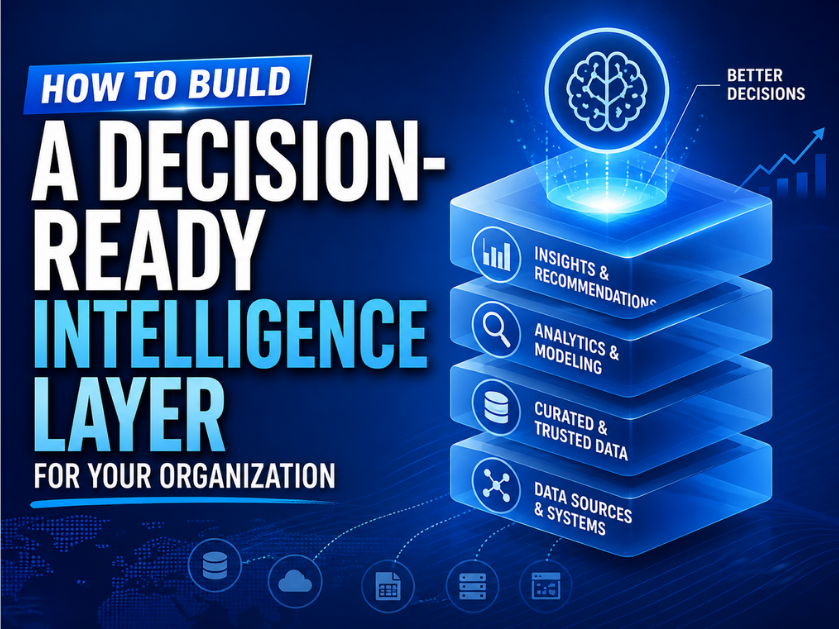
This is the problem that a decision-ready intelligence layer is designed to solve. Not by adding more data. By connecting what you already have into a coherent architecture that is built around one purpose: helping the right people make confident decisions faster.
|
A decision-ready intelligence layer is not a database or a platform. It is an architecture. The distinction matters enormously when you are trying to build one that actually works.
|
|
01
|
What Decision-Ready Intelligence Actually Means
Understanding the standard before you can build to it
|
The phrase decision-ready carries a specific meaning that is worth being precise about. Intelligence is decision-ready when it meets four criteria simultaneously.
- It is synthesized. It does not present raw data or isolated findings. It connects multiple sources into a coherent interpretation that is greater than the sum of its parts.
- It is contextualized. It speaks directly to a specific business question or decision rather than describing what the data shows in general terms.
- It is actionable. It gives the decision maker a clear basis for choosing between options rather than simply documenting what is known.
- It arrives at the right time. It is available before the decision point, not after someone has already committed to a direction and is looking for post-hoc validation.
Most enterprise organizations have plenty of intelligence that meets one or two of these criteria. Very few have built systems that consistently deliver intelligence meeting all four. That gap is exactly what a decision-ready intelligence layer closes.
The Five Dimensions of a Decision-Ready Intelligence Layer
A well-built intelligence layer covers five distinct dimensions. Each one plays a specific role in moving from fragmented data to confident decisions. The table below shows what decision-ready looks like across each dimension and where most organizations have gaps.
|
Intelligence Dimension
|
What Decision-Ready Looks Like
|
Common Gap
|
|
Customer Intelligence
|
Unified view of customer needs, behaviors, and attitudes across all segments
|
Siloed by team or channel with no shared synthesis
|
|
Market Intelligence
|
Continuous tracking of competitive dynamics, category shifts, and emerging signals
|
Commissioned reactively, delivered too late to influence decisions
|
|
Behavioral Analytics
|
Integrated behavioral data connected to strategic questions, not just reporting dashboards
|
Rich data exists but is not connected to research or market context
|
|
Predictive Signals
|
Forward-looking models that surface what is likely to happen next in key segments
|
Mostly backward-looking reporting with no predictive layer
|
|
Decision Architecture
|
Clear protocols for how intelligence flows to decision makers at the right time and format
|
No defined process; intelligence reaches leadership by chance not by design
|
If your organization has gaps in three or more of these dimensions, you do not yet have a decision-ready intelligence layer. You have components of one. The work of building it is primarily about connecting and organizing what you already have rather than acquiring more.
|
02
|
Why Most Intelligence Architectures Fall Short
The structural mistakes that keep organizations stuck
|
Most enterprise organizations have invested heavily in the individual components of a good intelligence architecture. They have research teams. They have analytics platforms. They have market intelligence subscriptions. They have behavioral data flowing from digital channels.
What they have not invested in is the connective architecture that turns those separate components into a unified intelligence system. The result is what most large organizations actually experience today: an intelligence landscape that is simultaneously data-rich and insight-poor.
The four structural gaps that appear most often
- No shared decision taxonomy. Different teams organize their intelligence around different questions, frameworks, and priorities. When leadership needs a synthesized view, there is no common structure to pull it together quickly.
- Intelligence is pull-based, not push-based. Information gets produced when someone asks for it. Nothing gets surfaced proactively. By the time a decision requires intelligence, it is usually too late to commission the right research or build the right analysis from scratch.
- Delivery is designed for producers, not consumers. Most intelligence outputs are formatted around what the research or analytics team found rather than around what the decision maker needs to know. The format serves the analyst, not the executive.
- No feedback loop between intelligence and decisions. When intelligence informs a decision, that connection is never captured. Teams never learn which types of intelligence had the most impact, so they cannot improve what they prioritize or how they present it.
|
The gap between data-rich and insight-poor is almost always an architecture problem. Buying more tools or hiring more analysts inside a broken architecture just creates more of the same problem at greater cost.
|
Do This, Not That: Common Intelligence Architecture Mistakes
Here is a direct comparison of the habits and choices that separate organizations building genuine decision-ready intelligence from those that keep investing in more of the same thing that is not working.
|
NOT THIS
|
|
DO THIS
|
|
✗ Start with available data and see what insights emerge
|
→
|
✓ Start with the decisions to be made and work backward to the intelligence needed
|
|
✗ Commission research reactively when a question arises
|
→
|
✓ Build a proactive intelligence calendar tied to the strategic planning cycle
|
|
✗ Deliver intelligence in long reports formatted for analysts
|
→
|
✓ Deliver synthesized briefings formatted for the specific decision at hand
|
|
✗ Measure success by number of reports and dashboards produced
|
→
|
✓ Measure success by the number of strategic decisions influenced and supported
|
|
✗ Keep research, analytics, and market intelligence in separate teams with separate outputs
|
→
|
✓ Integrate all three into a unified intelligence workflow with a shared synthesis layer
|
|
✗ Refresh the intelligence architecture when it breaks down
|
→
|
✓ Build continuous refresh into the architecture as a structural feature from day one
|
|
03
|
Building the Intelligence Layer: A Practical Framework
The six components every decision-ready system needs
|
Building a decision-ready intelligence layer is not a single project with a start date and an end date. It is an ongoing architecture that evolves as your organization’s strategic priorities evolve. That said, there is a clear set of components that every well-built intelligence layer includes and a logical sequence for putting them in place.
Component one: The decision inventory
The foundation of any decision-ready intelligence architecture is a clear map of the decisions that matter most. Before you touch any data or research, spend time with your leadership team building a decision inventory: a prioritized list of the ten to fifteen most consequential strategic choices your organization will face in the next twelve to eighteen months.
Every element of the intelligence layer should be traceable back to at least one item on this inventory. If it is not, it does not belong in the layer.
Component two: The intelligence audit
Once you have the decision inventory, map every existing intelligence asset against it. What research, data, and analytics do you currently have that speaks to each decision? Where are the gaps? What do you have that is not connected to anything on the inventory and should probably be deprioritized?
This audit almost always produces two surprises. First, organizations discover they have far more relevant intelligence than they realized. Second, they discover that a meaningful portion of what their teams are currently producing is not connected to any priority decision and is consuming resources that could be deployed more effectively.
Component three: The synthesis protocol
The synthesis layer is where separate intelligence streams get connected into unified insight. This requires both a process and a set of standards. Who is responsible for synthesis? How often does it happen? What format does synthesized intelligence take? How do you ensure consistency across different teams and data sources?
Building a synthesis protocol is the step most organizations skip because it is not glamorous and it does not produce immediately visible outputs. But without it, integration without synthesis just creates a better-organized collection of fragmented intelligence.
Component four: The delivery architecture
How intelligence reaches decision makers matters as much as the quality of the intelligence itself. A decision-ready delivery architecture defines the right format, the right cadence, and the right channel for each type of intelligence to reach each type of decision maker.
Strategic briefings for the executive team look different from tactical intelligence packages for operational leaders. Monthly synthesis reports serve a different purpose than real-time signal dashboards. The delivery architecture specifies what goes where, when, and in what form.
Component five: The proactive signal system
A decision-ready intelligence layer does not just answer questions. It monitors the environment for emerging signals that decision makers need to know about before they have thought to ask. This includes early indicators of competitive movement, shifts in customer sentiment, emerging market trends, and behavioral anomalies in key customer segments.
Building a proactive signal system requires defining what you are monitoring, how frequently, and what threshold triggers an active intelligence alert to leadership rather than waiting for the next scheduled briefing.
Component six: The feedback and refresh loop
The intelligence layer needs to learn and improve over time. The feedback loop captures which intelligence outputs actually influenced decisions, which were received but not acted on, and which arrived too late or in the wrong format to be useful. This feedback directly shapes what gets prioritized, how it gets packaged, and how the overall architecture evolves.
Without this loop, even well-built intelligence architectures drift out of alignment with organizational priorities over time. With it, they get sharper and more valuable with every strategic cycle.
Your Intelligence Layer Build Checklist
Use this checklist to assess how far along your organization is in building a genuine decision-ready intelligence layer. The checkmarks indicate what a fully built layer includes.
|

|
Decision inventory built: Leadership has mapped and prioritized the top strategic decisions for the next 12 to 18 months.
|
|
|
Intelligence audit complete: All existing data, research, and analytics assets have been mapped against the decision inventory.
|
|
|
Shared definitions established: Key terms including customer, segment, loyalty, and market are defined consistently across all teams.
|
|
|
Synthesis protocol in place: A clear process exists for integrating intelligence streams and producing synthesized briefings.
|
|
○
|
Delivery architecture designed: Intelligence formats and cadence are tailored to the specific needs of each decision maker audience.
|
|
○
|
Proactive signal system active: Continuous monitoring of competitive, customer, and market signals is feeding leadership proactively.
|
|
○
|
Feedback loop running: A structured process captures which intelligence influenced decisions and improves future prioritization.
|
If the top four items are checked and the bottom three are not, your organization is in the most common position: a solid foundation with the highest-impact components still to be built. That is not a criticism. It is an honest starting point.
What Changes When the Intelligence Layer Is Working
Organizations that successfully build a decision-ready intelligence layer tend to describe the change in similar terms. Not as a technical improvement but as a fundamental shift in how strategy feels.
- Decisions that used to take weeks start moving in days because the intelligence needed to make them is already synthesized and available rather than having to be commissioned and built from scratch.
- Cross-functional alignment that used to require multiple rounds of debate becomes faster and more natural because everyone is working from the same unified intelligence rather than their own team’s version of the truth.
- The insight and analytics function stops being seen as overhead and starts being treated as a genuine strategic asset because leadership can directly trace better decisions to the intelligence they received.
- Risk exposure on major strategic decisions drops measurably because the proactive signal system surfaces important information before it becomes a crisis rather than after.
- The organization starts compounding its strategic advantage because every cycle of good decisions produces better outcomes that feed back into sharper intelligence that enables even better decisions.
|
The organizations that build decision-ready intelligence layers do not just make better individual decisions. They build a structural advantage that makes every future decision faster, clearer, and more reliably good.
|
Where to Start
If your organization does not yet have a decision-ready intelligence layer, the most important thing to understand is that you do not have to build everything at once. The components described in this post are sequenced deliberately. You can start with a decision inventory this week. That single exercise will immediately clarify which of your existing intelligence assets are doing real work and which are consuming resources without producing strategic value.
From there, each component builds on the last in a logical sequence that produces visible improvements at every stage rather than requiring you to complete a multi-year architecture project before seeing any results.
The question is not whether your organization can afford to build this. Given what high-stakes decisions cost when they are made without adequate intelligence, the more honest question is whether you can afford not to.