Ask most enterprise leaders how their organization segments customers and you will hear something like this: we group them by age, income, and geography. Sometimes by how long they have been a customer. Maybe by product usage tier.
That is not wrong. But in most large organizations, it is nowhere near enough.
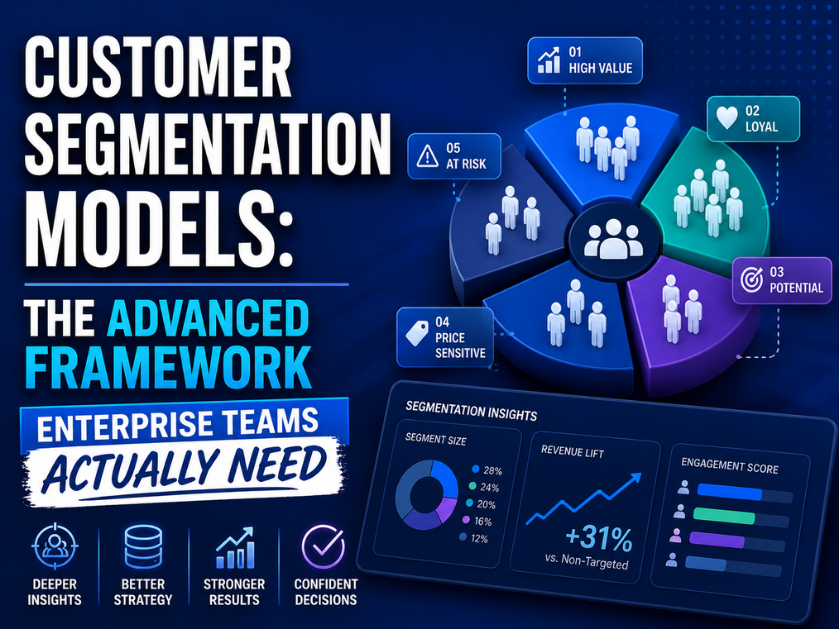
Customer segmentation models have been around for decades. The problem is that many enterprise teams are still using frameworks built for a simpler era, when data was scarce and behavioral insight was hard to capture at scale. Today, neither of those things is true. And organizations that have not updated their approach to segmentation are leaving significant strategic value on the table.
This post is about what advanced segmentation actually looks like at the enterprise level, why the basics fall short, and how to build a framework that drives real decisions rather than just filling slides.
Three Myths That Keep Enterprise Segmentation Stuck
|
MYTH: Segmentation is a one-time project.
|
|
REALITY: Customer behavior, market dynamics, and competitive conditions change constantly. A segmentation model built two years ago may already be describing customers who no longer exist in the same form. Advanced enterprise segmentation is a living system, not a finished deliverable.
|
|
MYTH: More segments means better segmentation.
|
|
REALITY: Adding more and more customer groups creates complexity without clarity. The goal of segmentation is not to describe every possible customer variation. It is to identify the groups that are most strategically distinct and most relevant to your business decisions. Fewer, sharper segments almost always outperform larger, fuzzier ones.
|
|
MYTH: Demographic segmentation is good enough for strategy.
|
|
REALITY: Demographics tell you who your customers are on paper. They say very little about why customers behave the way they do, what they value, how their needs are shifting, or which segment represents your highest future opportunity. Advanced segmentation layers behavioral, attitudinal, and predictive dimensions on top of demographics to answer those deeper questions.
|
|
The goal of customer segmentation is not to describe your customers. It is to make better decisions about how to serve, grow, and prioritize them.
|
What Makes a Segmentation Model Advanced
Basic segmentation divides customers into groups based on characteristics that are easy to observe and easy to collect. Advanced segmentation goes further by incorporating dimensions that reveal strategic insight rather than just demographic description.
There are five dimensions that separate a truly strategic segmentation framework from a standard one.
Behavioral dimensions
How do customers actually interact with your products and services? Purchase frequency, channel preference, feature adoption patterns, and service usage history all reveal things about a customer that no survey can capture. Behavioral data is often the most powerful single layer in an advanced segmentation model because it is based on what customers do, not just what they say.
Attitudinal dimensions
What do customers believe about your brand, your category, and the problem you solve? Attitudinal data comes from qualitative research, brand perception studies, and voice of customer programs. It tells you why different segments make the choices they make and what would need to change for them to choose differently.
Needs-based dimensions
What outcomes is each segment trying to achieve? Needs-based segmentation cuts across demographic and behavioral differences to identify groups defined by what they are trying to accomplish. This is especially powerful for product strategy and innovation because it helps teams understand where unmet needs represent real market opportunity.
Value and opportunity dimensions
Not all customer segments are equally valuable today, and not all of them have equal potential for tomorrow. Advanced segmentation includes a forward-looking view of each segment’s current revenue contribution, lifetime value potential, cost to serve, and strategic priority. This is what turns a segmentation model into a resource allocation tool.
Predictive dimensions
What is each segment likely to do next? Churn propensity models, next-product purchase likelihood, and growth trajectory forecasts add a predictive layer that shifts segmentation from a description of the present to a strategic map of the future. This is where modern data science and machine learning capabilities make the biggest difference.
What Changes When You Move to Advanced Segmentation
|
Without advanced segmentation
• Segments defined by demographics only
• Same strategy applied broadly across segments
• Resource allocation based on gut instinct
• Segmentation reviewed once every two years
• Marketing and product teams use different segment definitions
• No view of which segments will grow or shrink
|
|
With advanced segmentation
• Segments defined by behavior, attitude, needs, and value
• Distinct strategies designed for each high-priority segment
• Investment prioritized by segment opportunity and lifetime value
• Segmentation treated as a living model updated continuously
• One shared segment framework used enterprise-wide
• Predictive layer shows which segments to invest in now
|
The right side of that comparison is not a fantasy. It is what enterprise organizations achieve when they invest in building a segmentation model that is designed for strategy, not just for reporting.
A Six-Step Framework for Building Enterprise-Grade Segmentation
Here is how a well-structured advanced segmentation project unfolds inside a large organization. Each step builds on the last, and skipping any of them tends to create problems downstream.
|
1
|
Anchor on strategic decisions
Before collecting a single data point, identify the specific business decisions this segmentation model needs to support. Pricing strategy? Portfolio prioritization? Geographic expansion? Market entry? The decisions you are trying to make determine which segmentation dimensions matter most.
|
|
2
|
Audit existing data assets
Map every relevant data source already available inside the organization. CRM records, transaction data, survey archives, behavioral analytics, and third-party data sets all have a role to play. Most organizations discover they already have more raw material than they realized.
|
|
3
|
Conduct primary research to fill the gaps
Behavioral and transactional data alone cannot capture attitudes, motivations, and unmet needs. A well-designed primary research program, combining qualitative exploration with quantitative validation, fills the gaps that internal data cannot.
|
|
4
|
Build and validate the model
Use statistical clustering methods to identify natural groupings in the combined data set. Test the model for stability, distinctiveness, and strategic relevance. A good segmentation model produces groups that are measurably different from each other and meaningfully connected to business decisions.
|
|
5
|
Operationalize across the enterprise
A segmentation model only creates value when it is embedded into how the organization actually operates. This means creating a shared taxonomy, building segment identifiers into CRM and analytics systems, and aligning product, marketing, and strategy teams around a single customer framework.
|
|
6
|
Build a system for continuous refresh
Customer behavior changes. Market conditions shift. A segmentation model that was accurate at launch will drift over time if it is not actively maintained. Build a governance process and a refresh cadence into the model from the beginning, not as an afterthought.
|
The Strategic Payoff of Getting Segmentation Right
When advanced customer segmentation models are built and embedded correctly, the impact shows up across nearly every strategic function in the organization.
- Product and innovation: Teams can prioritize features and new offerings around the needs of their highest-value and highest-growth segments rather than trying to serve everyone equally.
- Marketing and growth: Messaging, channel strategy, and acquisition investment all become more precise when they are built around segment-specific insights rather than broad averages.
- Pricing and revenue strategy: Segment value analysis reveals which customers are most price sensitive and which represent untapped willingness to pay, creating clearer pricing architecture decisions.
- Customer experience and retention: Understanding behavioral and attitudinal differences between segments makes it possible to design experiences that reduce churn for at-risk groups and deepen loyalty in high-value ones.
- Executive strategy and resource allocation: A shared, enterprise-wide segmentation framework gives leadership teams a common lens for making investment decisions across business units, geographies, and product lines.
|
Organizations with advanced segmentation capabilities consistently allocate resources more efficiently, grow faster in priority segments, and lose fewer high-value customers to competitors.
|
Why Advanced Segmentation Projects Often Fall Short
Even organizations that invest seriously in segmentation sometimes end up with a model that sits in a presentation deck and never makes it into day-to-day operations. Here are the most common reasons why.
- The model was built for the research team, not for the business. When segmentation outputs are designed primarily for analytical audiences rather than operational ones, adoption stalls. The model needs to be translatable into the language and workflows of marketing, product, sales, and strategy teams.
- Operationalization was treated as an afterthought. Building the model is the exciting part. Embedding it into CRM systems, analytics platforms, and planning processes is harder and less glamorous. Organizations that skip this step end up with a beautiful model that generates no ongoing value.
- There was no executive sponsor driving adoption. Segmentation transformation requires cross-functional alignment. Without a senior leader championing the model and holding teams accountable for using it, each function tends to default back to their own customer definitions within a few months.
- The model was never refreshed. Customer behavior changes. If nobody owns the ongoing maintenance of the segmentation model, it quietly becomes outdated while the organization continues making decisions based on a picture of the customer that no longer exists.
Final Word
Customer segmentation models are one of the most powerful strategic tools available to enterprise organizations. They are also one of the most frequently underbuilt.
The difference between a basic segmentation model and an advanced one is not just analytical sophistication. It is whether the model was designed to describe customers or to drive decisions about them. Organizations that build with that distinction in mind tend to see faster strategic alignment, more confident resource allocation, and a clearer picture of where their best growth opportunities actually live.
If your current segmentation model feels more like a research artifact than a living strategic asset, that is worth examining carefully. The good news is that the path from where most organizations are to where they need to be is well-defined and very achievable with the right framework and the right partner.