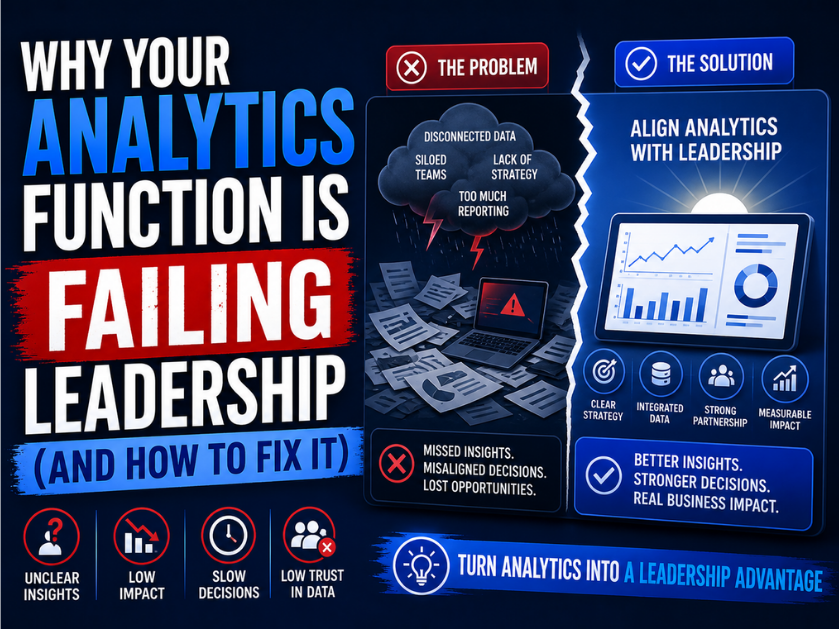
Analytics transformation strategy is becoming essential for enterprise organizations that want to turn fragmented reporting systems into clearer and more effective business decision making. Before we get into the why, take sixty seconds and run through this quick diagnostic. It will tell you more about your analytics function than most internal reviews ever do.
|
Analytics Function Diagnostic
Check every statement that is true for your organization.
|
|
□ Leadership regularly asks for data but rarely acts on what they receive.
|
|
□ Your analytics team spends more time on recurring reports than on strategic questions.
|
|
□ Different teams present conflicting numbers in the same executive meeting.
|
|
□ Senior leaders describe the analytics function as a support group rather than a strategic partner.
|
|
□ Requests for insight come after decisions have already been made, not before.
|
|
□ New dashboards and tools keep getting added but leadership confidence has not improved.
|
|
□ The analytics team is measured on output volume rather than on decision impact.
|
|
□ When a big strategic question arises, no one is certain which team owns the answer.
|
|
Score: If you checked 3 or more of these, your analytics function has a structural problem worth addressing. If you checked 5 or more, this post was written for you.
|
If that checklist felt uncomfortably familiar, you are not alone. This pattern shows up inside some of the most data-rich organizations in the world. Companies that have invested millions in analytics platforms, hired large teams of talented analysts, and built infrastructure that most organizations would envy, and yet still find that leadership does not trust the intelligence they receive.
The problem is almost never the data. It is the structure.
The Core Disconnect Between Analytics Teams and Executive Leadership
Most analytics functions were built to answer questions. Leadership asks for a number, the team produces it. Leadership asks for a trend, the team charts it. Leadership asks for a comparison, the team builds a dashboard.
That model made sense in an era when data was hard to access and analysis took time. But the world has changed. Data is now abundant. Analysis can be automated. And what leadership actually needs from an analytics function has shifted fundamentally.
Today, the most valuable thing an analytics function can deliver is not a faster answer to a specific question. It is proactive, synthesized intelligence that helps leadership navigate the decisions they have not even articulated yet.
|
“I do not need more charts. I need someone who can tell me what the charts mean for the decision I have to make on Thursday.”
— Chief Strategy Officer, Fortune 500 Consumer Goods Company
|
That sentiment is more common than most analytics leaders realize. And it points directly at the structural gap that sits at the heart of most analytics transformation challenges.
How Does Your Analytics Function Rate Right Now?
Not all analytics functions fail in the same way or at the same depth. Here is a simple way to assess where your organization currently sits across three dimensions that matter most to leadership.
| |
Analytics Function
|
What Leadership Experiences
|
|

|
At Risk
|
Operates primarily as a reporting factory. Responds to ad hoc requests. No proactive intelligence. Leadership views it as a cost center.
|
|
|
At Risk
|
Output is measured in reports produced and dashboards built. No connection to strategic decisions made or influenced.
|
|
|
At Risk
|
Each business unit runs its own analytics. No shared definitions, no unified customer view, no cross-functional synthesis.
|
|

|
Developing
|
Delivers regular insight reports to leadership. Some strategic projects but still mostly reactive. Beginning to build proactive capabilities.
|
|
|
Developing
|
Starting to measure decision impact but inconsistently. Some wins visible but not systematically tracked or communicated.
|
|
|
Developing
|
Some shared definitions across teams. Partial integration of data sources. Inconsistent use of common frameworks.
|
|

|
Optimized
|
Proactively surfaces intelligence tied to leadership priorities. Anticipates strategic questions before they are asked.
|
|
|
Optimized
|
Measured primarily on decisions influenced and strategic questions answered. Seen as indispensable by the executive team.
|
|
|
Optimized
|
Single unified customer intelligence framework used enterprise-wide. All teams working from the same data, definitions, and synthesis.
|
Most enterprise analytics functions sit firmly in the amber zone, which means they are doing useful work but have not yet made the transition from reactive reporting to proactive strategic partnership. The distance from amber to green is not primarily a technology problem. It is a mandate, structure, and measurement problem.
The Seven Reasons Analytics Functions Lose the Confidence of Leadership
Every organization has its own specific story, but the underlying failure patterns are remarkably consistent. Here are the seven that appear most often when analytics functions are not delivering what leadership needs.
The mandate was built around production, not impact
When analytics teams are hired, staffed, and evaluated based on how much they produce, they naturally optimize for production. More reports, more dashboards, more data pulls. But volume of output is not the same as strategic value. The teams that earn and keep the confidence of leadership are the ones that measure themselves by the decisions they support and the clarity they create.
Intelligence is delivered without context or recommendation
A table of numbers is not intelligence. A chart of trends is not intelligence. Intelligence is a synthesized interpretation of what the data means in the context of a specific business challenge, paired with a clear point of view on what leadership should consider doing about it. Most analytics functions stop two steps short of that and then wonder why leadership does not act on their work.
|
“The team brings me data. What I need is someone who has already thought through what the data means and is willing to tell me what they think we should do.”
— EVP of Strategy, Global Financial Services Organization
|
The team answers the questions it is asked instead of the ones that matter
Reactive analytics functions build their entire workflow around incoming requests. Whatever leadership asks for, the team delivers. The problem is that leadership does not always know which questions to ask. The most valuable analytics teams proactively identify the intelligence gaps that matter most to the organization’s strategic agenda and fill them before being asked.
Data definitions are not standardized across the organization
When the marketing team, the finance team, and the product team all define customer retention differently, every cross-functional meeting becomes a debate about the numbers before anyone gets to the actual decision. Standardizing definitions is unglamorous work. But it is one of the single highest-leverage investments an analytics function can make in its own strategic credibility.
The insight function is too far from the decision
In many large organizations, analytics teams sit several layers removed from the executive decision-making process. Their work gets filtered, summarized, and reinterpreted by layers of management before it reaches the people who actually need it. Each layer adds latency and removes nuance. Analytics functions that have the most impact tend to have direct lines to leadership, either through reporting structure or through regular strategic briefings.
Technology investment runs ahead of strategic clarity
There is a pattern that shows up repeatedly in analytics transformation projects. An organization invests in a new platform, hires a team to run it, and then discovers that better technology did not fix the fundamental problem of what intelligence to produce and how to connect it to decisions. Tools amplify the strategy. They cannot substitute for it.
|
Every analytics transformation that starts with a technology purchase and ends with a strategic disappointment made the same mistake: solving a structure problem with a software solution.
|
Success is never clearly defined or demonstrated
Analytics functions that cannot clearly articulate what success looks like for their work tend to be seen as overhead. The most strategically positioned analytics teams build explicit frameworks for demonstrating their value in terms that leadership cares about: decisions accelerated, strategic risks avoided, revenue opportunities identified, alignment created. If your team cannot point to specific strategic outcomes it influenced in the last twelve months, that is a problem worth solving before the next budget cycle.
The Four-Phase Analytics Transformation Roadmap
Fixing an analytics function that is failing leadership is not a single project. It is a phased transformation that requires changes to mandate, structure, measurement, and ultimately culture. Here is how the most effective transformations unfold.
|
Phase
|
Timeframe
|
Focus
|
Leadership Outcome
|
|
01
|
Months 1 to 2
|
Mandate reset. Redefine the analytics function around decision support rather than reporting production. Establish new success metrics tied to strategic impact.
|
Leadership alignment on what analytics is for.
|
|
02
|
Months 2 to 4
|
Intelligence audit. Map every current output to a specific decision it supports. Kill anything that does not connect. Identify the top strategic questions without owners.
|
Clarity on where the real gaps are.
|
|
03
|
Months 3 to 9
|
Structural redesign. Standardize definitions, integrate data sources, build proactive intelligence workflows, and redesign delivery formats around decision makers.
|
Leadership starts receiving intelligence they can act on.
|
|
04
|
Ongoing
|
Strategic positioning. Embed the analytics function into the strategic planning cycle. Build direct access to executive decision makers. Continuously measure and communicate impact.
|
Analytics recognized as a strategic asset, not a support function.
|
What a High-Performing Analytics Function Actually Looks Like
It is worth being specific about what success looks like on the other side of this transformation, because the destination shapes every decision you make about the journey.
- Leadership requests fewer reports because the intelligence they need is already arriving proactively in the format and cadence that fits their decision cycle.
- Strategic alignment improves because everyone in the organization is working from the same definitions, the same data sources, and the same synthesized view of the customer and market.
- The analytics team has a seat at the executive table because it has demonstrated, repeatedly and measurably, that its work changes the quality of the decisions leadership makes.
- Budget conversations get easier because the function can point to specific strategic outcomes it has influenced rather than simply defending headcount and tool costs.
- The organization makes better decisions faster because it has a proactive intelligence layer that anticipates the questions leadership will need to answer before those questions become urgent.
|
“When the analytics function finally started showing up with intelligence tied to our actual agenda rather than reports tied to last quarter, everything changed. We stopped treating them like a support team and started treating them like partners.”
— Chief Marketing Officer, Global Retail Organization
|
The Honest Assessment
If your analytics function is failing leadership, the people on that team almost certainly know it. Talented analysts do not enjoy spending their careers building reports that nobody acts on. They want to do work that matters. The structural conditions that prevent that from happening are almost always fixable.
The path from a reporting factory to a genuine strategic intelligence function is not short. But it is well-defined. It starts with an honest assessment of where the real problems are, a clear mandate reset, and the willingness to measure success by the decisions influenced rather than the outputs delivered.
Organizations that make that shift do not just get better analytics. They get a fundamentally different relationship between intelligence and strategy, one where the data their teams produce becomes a genuine source of competitive advantage rather than a line item on the cost side of the ledger.
That transformation is available to almost every enterprise organization that decides to pursue it seriously. The question is not whether it is possible. It is whether the organization has the clarity, the mandate, and the right partner to make it happen.