Most enterprise organizations are drowning in data. Reports stack up. Dashboards multiply. Analytics teams are stretched thin responding to request after request. And yet, when a major strategic decision lands on an executive’s desk, confidence is often surprisingly low.
That gap between data abundance and decision confidence is exactly what decision-grade intelligence is designed to close.
If you have never encountered the term before, you are not alone. It is not a buzzword borrowed from a technology vendor. It is a standard of quality, a way of thinking about what insight actually needs to look like before it earns a seat at the strategy table.
What Decision-Grade Intelligence Actually Means
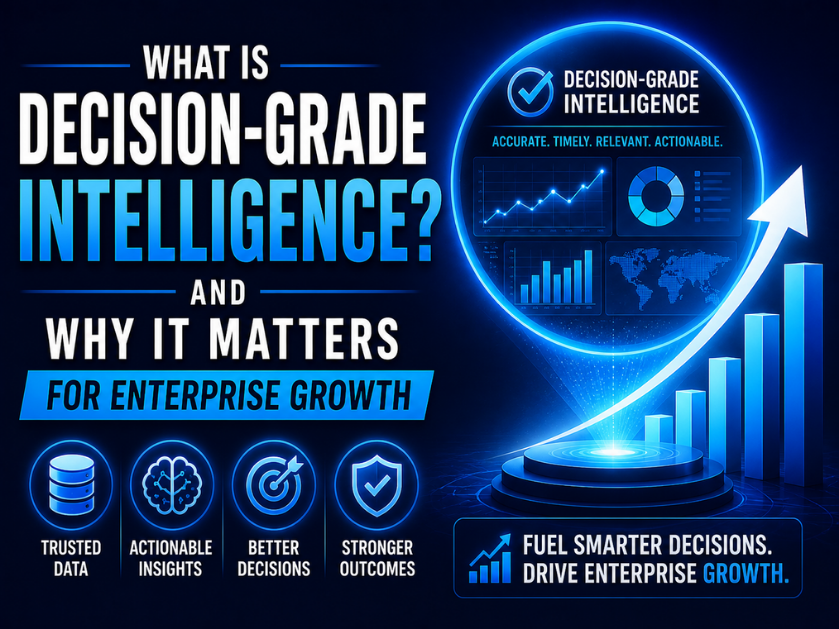
Decision-grade intelligence is customer and market insight that has been synthesized, validated, and structured specifically to support high-stakes executive decisions. It is not a raw data export. It is not a monthly performance report. It is intelligence that has been held to a higher standard.
Think of it this way. Data tells you what happened. Analytics tells you patterns within what happened. Decision-grade intelligence tells you what it means, what the risk profile looks like, what the strategic options are, and what the most defensible path forward appears to be.
The word grade is deliberate. Just as there are grades of fuel, grades of material, and grades of classification, there are grades of intelligence. Most organizations are operating on low-grade intelligence at high-stakes moments. They are making billion-dollar calls with insights that were never designed for that level of pressure.
Why So Many Enterprise Leaders Struggle with This
The problem is rarely a lack of investment. Most large organizations have already spent heavily on data infrastructure, analytics platforms, research subscriptions, and insight teams. The investment is there. The output is not.
Here is what tends to go wrong.
Fragmentation
Customer data lives in separate systems across separate teams. Market research sits in one department. Behavioral analytics sits in another. Voice of customer sits somewhere else entirely. No one has stitched it into a single, coherent picture.
Reactive Positioning
Insight functions are often organized around responding to requests rather than proactively anticipating what leadership will need. By the time a major strategic question surfaces, there is rarely time to build the right foundation of evidence.
Output That Informs but Does Not Guide
There is a meaningful difference between a report that informs a room and intelligence that guides a decision. Most enterprise insight outputs land in the first category. They present findings without structuring them around the decision that actually needs to be made.
These are not technology problems. They are architectural problems. They are about how insight functions are designed, positioned, and connected to strategy.
The Four Standards of Decision-Grade Intelligence
Not every insight meets the bar. Here is what separates decision-grade intelligence from standard reporting.
1. It Is Built Around a Decision, Not a Question
Standard research answers questions. Decision-grade intelligence is structured around a specific choice that needs to be made. Who is the decision-maker? What are the real options on the table? What would change the recommendation? What is the cost of being wrong?
Starting with the decision rather than the data changes everything about how the work is scoped, synthesized, and presented.
2. It Integrates Multiple Streams of Evidence
No single data source carries enough credibility on its own for a major strategic call. Decision-grade intelligence pulls from primary research, behavioral data, competitive intelligence, financial modeling, and operational context. It triangulates. It surfaces agreement and tension across sources rather than cherry-picking the narrative that feels cleanest.
3. It Is Calibrated for Confidence, Not Just Completeness
A 200-page research report can be comprehensive and still leave executives no more confident than when they started. Decision-grade intelligence is calibrated for confidence. It separates what is known with high certainty from what is inferred, from what remains genuinely uncertain. It gives leadership a realistic picture of how much they can rely on each element of the case.
4. It Has a Point of View
This is perhaps the most important and most underused standard. Decision-grade intelligence does not end with here is what the data shows. It ends with a clear synthesis of what the evidence suggests, what the strategic implications are, and what a thoughtful, senior practitioner would recommend given the full picture.
That last step requires expertise, not just analysis.
How Decision-Grade Intelligence Drives Enterprise Growth
The connection to growth is direct, even if it is not always named that way in boardrooms.
Faster Cycle Times on Major Decisions
When leadership has integrated, synthesis-ready intelligence on hand, they move faster. They spend less time debating whether the data is trustworthy and more time evaluating the actual strategic options.
Fewer Expensive Mistakes
High-quality intelligence identifies blind spots before they become costly. It surfaces the customer dynamics, competitive shifts, or market signals that gut instinct alone would miss. The reduction in strategic error more than justifies the investment in building the intelligence function properly.
Stronger Alignment Across Leadership
Fragmented insights create fragmented conclusions. When different parts of the C-suite are working from different data sets and different interpretations, alignment is nearly impossible. Decision-grade intelligence creates a shared, authoritative foundation that unifies executive thinking around a single version of the truth.
Better Resource Allocation
When organizations know with greater precision what their customers actually value, where the market is moving, and where the real growth leverage exists, capital and talent flow toward higher-return bets.
What Building This Capability Looks Like in Practice
Shifting from standard reporting to decision-grade intelligence is not a software implementation. It is a transformation of how an insight function is structured, what it produces, and how it connects to leadership.
It typically involves three shifts.
The first is moving from reactive to proactive. The insight function needs to be positioned upstream of decisions, not downstream of requests. That means understanding the strategic calendar, the decisions on the horizon, and building intelligence before the urgent moment arrives.
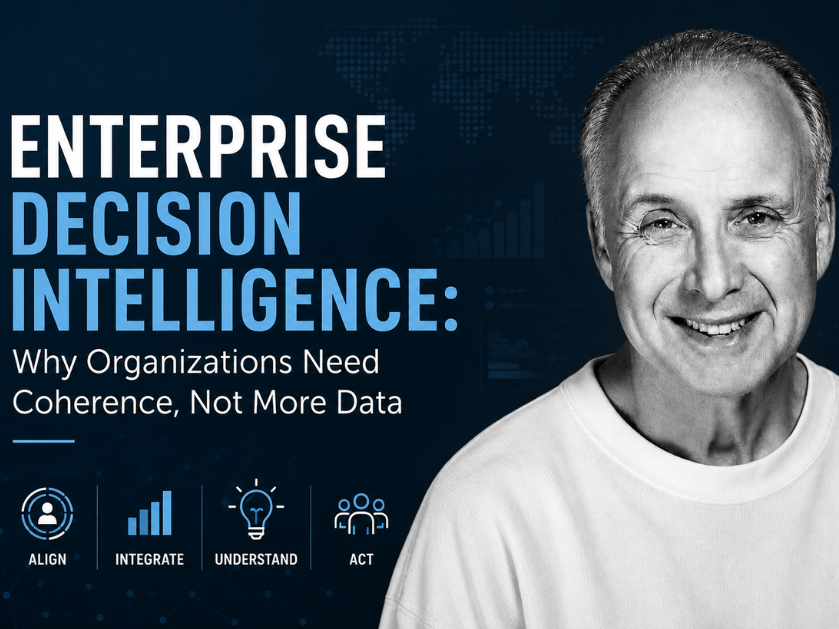
The second is integrating across silos. Customer insights, market research, behavioral analytics, and competitive intelligence need to operate as a unified system rather than isolated specialties. This requires both structural changes and a unifying framework for synthesis.
The third is raising the standard of output. Deliverables need to be designed for decisions, not just for documentation. That means shorter, sharper synthesis. It means explicit statements of confidence. It means a clear point of view from people with the expertise to hold one.
Who Needs Decision-Grade Intelligence Most
Any organization facing high-stakes decisions with significant uncertainty and meaningful consequences benefits from this kind of intelligence.
That typically means large enterprises navigating market expansion, product portfolio decisions, mergers and acquisitions, customer strategy transformations, or competitive repositioning. It also applies to organizations that have undergone significant digital transformation and now sit on large data assets they have not yet learned to translate into executive-grade insight.
The organizations that feel this gap most acutely are usually those that have invested in the data infrastructure but have not yet invested equally in the intelligence architecture that turns that data into something leadership can actually use.
A Note on Why This Term Matters
Decision-grade intelligence is not a marketing phrase. It is a useful distinction because it forces the right question at the start of any insight initiative: are we building something that can genuinely support a decision at the highest level of the organization, or are we building something that will satisfy a reporting requirement?
That question changes what gets built, how it gets built, and what it is ultimately worth.
For enterprise leaders who feel the gap between the data they have and the confidence they need, closing it is not a technology purchase. It is a strategic priority.
Frequently Asked Questions
What is the difference between business intelligence and decision-grade intelligence?
Business intelligence typically refers to the tools, dashboards, and data platforms that help organizations track performance. Decision-grade intelligence refers to synthesized, expert-interpreted insight that is specifically structured to support a particular high-stakes decision. One describes infrastructure; the other describes a standard of output.
How is decision-grade intelligence different from market research?
Market research is one input into decision-grade intelligence. Decision-grade intelligence integrates market research with behavioral data, competitive analysis, financial context, and expert synthesis into a unified perspective that is explicitly built around a strategic decision. It is broader, more integrated, and more prescriptive than standard market research.
Can smaller organizations build decision-grade intelligence capabilities?
The principles apply at any scale, but the investment in infrastructure and talent required to build this capability internally is typically most practical for mid-size to large enterprises. Smaller organizations often access this kind of intelligence through specialized consulting partnerships.
What role does AI play in decision-grade intelligence?
AI and machine learning can significantly accelerate pattern recognition, customer segmentation, and predictive modeling within a decision-grade intelligence system. However, the synthesis, calibration for confidence, and strategic point of view still require experienced human judgment. AI is a powerful component of the system, not a replacement for the system.
How does decision-grade intelligence reduce strategic risk?
By surfacing blind spots, quantifying uncertainty, integrating multiple streams of evidence, and separating what is known from what is assumed, decision-grade intelligence helps leadership avoid the overconfidence and information gaps that most commonly drive costly strategic errors.
Conclusion
Decision-grade intelligence is what happens when an organization stops treating insight as a reporting function and starts treating it as a strategic asset. It is the difference between data that sits in a dashboard and intelligence that walks into the boardroom ready to support the most consequential decisions a leadership team will make.
For enterprise organizations navigating increasingly complex markets, building this capability is not a luxury. It is a competitive requirement. The leaders who invest in turning their fragmented data, research, and analytics into integrated, decision-ready intelligence will consistently make faster, more confident, and better-calibrated strategic decisions than those who do not.
That is the case for decision-grade intelligence. And it is a strong one.
About the Author: Mack Turner is the founder of Mack Turner Marketing Consulting and Insights. He brings decades of senior leadership experience at the intersection of customer insights, advanced analytics, and enterprise strategy, including his work directing global customer intelligence at Bank of America Merrill Lynch.