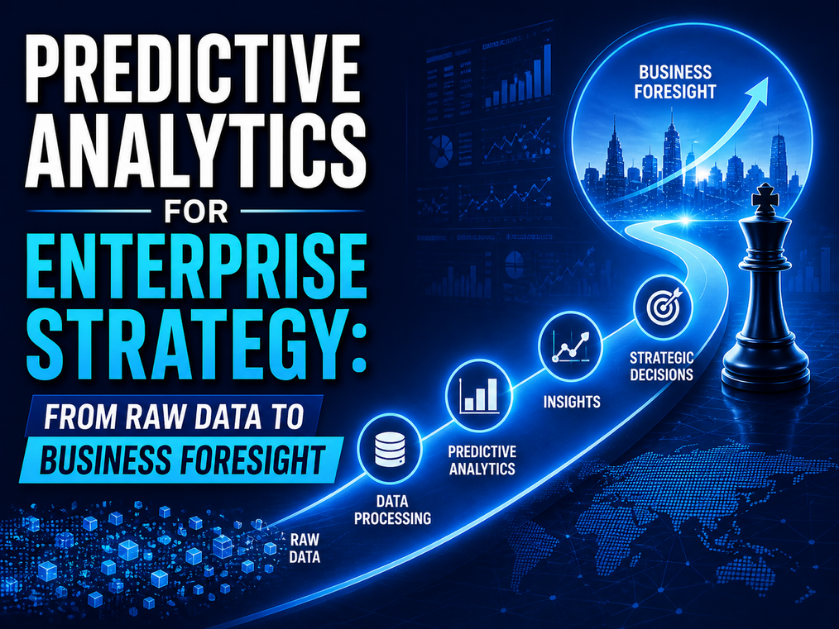
Predictive analytics for enterprise strategy is helping organizations transform raw data into faster and more confident decision-making.
Most enterprise organizations today are sitting on more data than any previous generation of business leaders could have imagined. Transaction records, customer behavior logs, market feeds, financial data, operational metrics, the volume is staggering. And yet, for many leadership teams, the strategic question remains the same as it was decades ago: what is going to happen next, and how confident can we be about it?
That’s the problem predictive analytics for enterprise strategy was built to solve.
Predictive analytics doesn’t just tell you what has happened. It uses historical data, statistical modeling, and machine learning to generate probabilistic forecasts about future outcomes, giving enterprise leaders something far more valuable than hindsight or even current-state visibility. It gives them foresight.
This guide is written for enterprise executives, insight leaders, and strategy professionals who want to understand what predictive analytics actually delivers in a business context, where it creates the most value, and what it takes to implement it effectively at scale.
What Is Predictive Analytics? A Business-First Definition
Predictive analytics is the use of statistical algorithms, machine learning models, and historical data to forecast future events, behaviors, or trends. In a business context, it moves organizations from a reactive posture, responding to what has already occurred, to a proactive one, where leadership can anticipate what is likely to occur and position accordingly.
It’s important to separate the technical definition from the business application. The models themselves, regression analysis, decision trees, neural networks, and gradient boosting are the engine. But the real value in enterprise settings is the strategic output: faster decisions, reduced uncertainty, and more confident resource allocation.
|
Predictive analytics is not about predicting the future with certainty. It is about quantifying uncertainty in a way that makes decisions more defensible, faster, and less exposed to avoidable risk.
|
When executive teams understand predictive analytics through this lens — as a tool for structured foresight rather than a crystal ball, adoption barriers tend to drop significantly.
The Analytics Maturity Model: Where Predictive Fits
To understand the value of predictive analytics, it helps to place it in the context of the broader analytics maturity spectrum. Most organizations progress through distinct stages of analytical capability, each building on the one before it.
|
Maturity Level
|
Capability
|
Data Input
|
Business Output
|
|
Level 1 Descriptive
|
What happened?
|
Historical reports, dashboards
|
Operational awareness
|
|
Level 2 Diagnostic
|
Why did it happen?
|
Root cause analysis, drill-downs
|
Problem identification
|
|
Level 3 Predictive
|
What will happen?
|
ML models, statistical forecasting
|
Strategic foresight
|
|
Level 4 Prescriptive
|
What should we do?
|
Optimization algorithms, simulations
|
Decision automation
|
|
Level 5 Cognitive
|
What don’t we know yet?
|
AI-driven signal detection
|
Proactive opportunity capture
|
The majority of enterprise organizations today operate comfortably at Levels 1 and 2, descriptive and diagnostic analytics. They have dashboards, reporting infrastructure, and the ability to investigate performance problems after the fact. But strategic advantage increasingly lives at Levels 3 and 4.
Organizations that have successfully moved into predictive and prescriptive analytics are not just better informed, they are structurally better positioned to outpace competitors who are still reading yesterday’s reports while their rivals are acting on tomorrow’s probabilities.
From Raw Data to Business Foresight: How the Process Works
One of the most common misconceptions about predictive analytics in enterprise settings is that raw data automatically translates into insight. It doesn’t. The journey from data to strategic foresight involves several distinct stages, each requiring both technical rigor and business judgment.
Stage 1: Data Unification and Preparation
Predictive models are only as good as the data they are trained on. In most enterprises, relevant data is fragmented across systems, CRM platforms, financial databases, marketing tools, operational records, and third-party sources. The first step is always to unify, clean, and structure this data into a format that modeling can work with.
This stage is unglamorous but non-negotiable. Organizations that invest in strong data infrastructure at this step produce dramatically better predictive outcomes than those who try to skip ahead to modeling with messy inputs.
Stage 2: Feature Engineering and Model Selection
Feature engineering is the process of selecting and transforming variables from your data that are likely to have predictive power for the outcome you care about. For a churn prediction model, relevant features might include recency of purchase, frequency of support contacts, and engagement with key product features.
Model selection depends on the nature of the prediction: classification models for binary outcomes (will this customer churn; yes or no?), regression models for continuous outcomes (what will this customer’s lifetime value be?), and time-series models for sequential forecasting (what will demand look like over the next six months?).
Stage 3: Model Training, Testing, and Validation
Models are trained on historical data and then tested against a held-out validation set to assess accuracy. This step requires careful attention to overfitting, where a model performs well on training data but poorly on new data, and to ensuring the model generalizes reliably to real-world inputs.
Stage 4: Translation into Strategic Language
This is the step where most enterprise predictive analytics initiatives either succeed or fail. A model that produces a statistically sound forecast still needs to be translated into the language of business decisions, what this means for market positioning, resource allocation, risk exposure, or timing of strategic moves.
The best enterprise analytics functions are staffed with professionals who can move fluidly between the technical and strategic domains. They understand the model well enough to explain its limitations honestly, and they understand the business well enough to connect its outputs to what actually matters in the boardroom.
Stage 5: Embedding Predictions into Decision Workflows
A prediction that lives in a data science team’s repository has no strategic value. Predictions create value when they are embedded into the workflows where decisions actually happen, in quarterly strategy reviews, in pricing committee meetings, in resource planning cycles, and in real-time operational dashboards.
|
The most overlooked step in enterprise predictive analytics is not the modeling; it is the operationalization. Building the model is maybe 20% of the work. Getting it used by the people making the decisions is the other 80%.
|
High-Value Applications Across Enterprise Functions
Predictive analytics creates value across virtually every enterprise function when applied to the right questions. The table below illustrates some of the highest-impact applications currently deployed in leading organizations.
|
Industry / Function
|
Predictive Analytics Application
|
Strategic Outcome
|
|
Financial Services
|
Customer churn prediction, credit risk modeling
|
Retain high-value customers, reduce default exposure
|
|
Retail & Consumer
|
Demand forecasting, inventory optimization
|
Reduce stockouts, lower carrying costs
|
|
Healthcare
|
Patient risk stratification, readmission prediction
|
Improve outcomes, reduce cost of care
|
|
B2B Enterprise
|
Sales pipeline forecasting, account scoring
|
Improve revenue predictability, prioritize sales effort
|
|
Strategy & Planning
|
Scenario modeling, market shift anticipation
|
Stronger strategic plans with quantified risk ranges
|
What these use cases share is a common structure: historical patterns are used to generate probabilistic forecasts about future states, and those forecasts are then connected directly to a decision that leadership needs to make. The business question always comes first. The model follows.
The Role of AI-Enabled Analytics in Enterprise Strategy
Predictive analytics has existed in some form for decades. What has changed dramatically in recent years is the combination of data volume, computational power, and machine learning sophistication that now enables enterprises to build more accurate, more granular, and more real-time predictive capabilities than were previously feasible.
AI-enabled analytics specifically refers to the application of machine learning algorithms that can detect complex, non-linear patterns in large datasets, patterns that traditional statistical models would miss. In enterprise strategy contexts, this translates into several meaningful advances:
- Higher-accuracy churn, demand, and risk forecasting models that update continuously as new data arrives
- Natural language processing capabilities that enable sentiment analysis at scale across customer feedback, news, and market signals
- Anomaly detection that surfaces early warning signals before they become strategic threats
- Scenario simulation that allows leadership teams to model the impact of strategic choices before committing resources
It is worth being direct about what AI-enabled analytics does not do. It does not eliminate the need for human judgment. It does not account for unprecedented black swan events. And it does not produce certainty, only improved probability estimates. Organizations that treat AI model outputs as directives rather than inputs to human decision-making are misusing the technology.
|
The most strategically sophisticated enterprises use AI-enabled analytics to narrow the range of uncertainty, not to eliminate it. Leadership still decides. The models make those decisions more defensible.
|
What Enterprise Leaders Get Wrong About Predictive Analytics
After working with enterprise organizations at the intersection of analytics and strategy, certain failure patterns emerge consistently. Being honest about them is the first step toward avoiding them.
Treating Data Infrastructure as Someone Else’s Problem
Predictive analytics requires clean, unified, well-governed data. When executive leadership treats data infrastructure as a purely technical concern to be managed by IT, the analytics function is set up to struggle. Data strategy is a business strategy decision, and it requires executive ownership.
Building Models Before Defining the Business Question
Organizations sometimes invest in analytical capabilities before they have clearly articulated what decisions those capabilities are meant to support. The result is technically impressive outputs that no one acts on. The business question, the decision to be made, the risk to be quantified, and the opportunity to be evaluated must come first.
Declaring Victory After the Model Is Built
Model development is not the end of the project. It is the beginning of the operationalization challenge. Organizations that fail to invest in change management, user adoption, and workflow integration rarely see returns from predictive analytics investments.
Underinvesting in the Translation Layer
The gap between a statistically valid model and a decision a CEO will act on is bridged by people who can speak both languages. This translation capability, call it decision science, insight communication, or strategic analytics, is consistently one of the most underinvested capabilities in enterprise insight functions.
Building a Predictive Analytics Capability at Enterprise Scale
For enterprise leaders looking to build or mature predictive analytics capabilities, the path forward typically involves four interconnected investments:
1. Unified Data Infrastructure
Before meaningful predictive modeling is possible, the organization needs a unified data environment, one that connects disparate data sources, enforces consistent definitions, and makes data accessible to the teams that need it. Cloud data platforms have made this significantly more achievable in recent years, but it still requires deliberate investment and governance.
2. Talent With Both Technical and Business Fluency
The ideal predictive analytics team includes data scientists who understand model development and validation, and business-facing analysts who can translate outputs into strategic implications. The rarest and most valuable profile is someone who can move fluidly between both.
3. Executive Sponsorship and Decision Workflow Integration
Predictive analytics capabilities need an executive champion who will ensure model outputs are actually reviewed, discussed, and acted upon at the leadership level. Without this, even technically excellent capabilities go unused.
4. A Culture of Evidence-Based Decision-Making
Perhaps the most important, and most difficult, investment is cultural. Predictive analytics thrives in organizations where leadership values evidence over intuition, where uncertainty is acknowledged rather than suppressed, and where the quality of a decision is judged by the process that produced it, not just the outcome.
|
At its highest level, predictive analytics for enterprise strategy is not a technology initiative. It is a cultural and organizational capability, one that makes the entire enterprise more rigorous, more forward-looking, and more resilient.
|
From Raw Data to Business Foresight: The Strategic Imperative
The enterprise leaders who will outperform their peers over the next decade are not necessarily those with the most data. They are the ones who have built the capability to convert data into foresight, systematically, reliably, and at the speed that modern markets demand.
Predictive analytics for enterprise strategy is the discipline that bridges that gap. It transforms fragmented raw data into probabilistic intelligence. It replaces gut-driven decisions with evidence-backed ones. And it gives executive teams the analytical confidence to act decisively when the stakes are highest.
The technology to do this is more accessible than it has ever been. The data to fuel it exists in virtually every enterprise. What separates organizations that capture the value from those that don’t is the deliberate investment in building the analytical capability, the organizational structures, and the decision workflows that make predictive intelligence actionable.
|
At Mack Turner Marketing, we help enterprise organizations build the integrated intelligence infrastructure, from data unification to decision-grade predictive modeling, that enables leadership to move from reacting to leading. If you’re exploring what predictive analytics could mean for your strategic function, let’s have that conversation.
|
Frequently Asked Questions
Q1: What is the difference between predictive analytics and business intelligence?
Business intelligence (BI) is primarily descriptive; it tells you what has already happened through dashboards, reports, and data visualizations. Predictive analytics goes further, using statistical models and machine learning to forecast what is likely to happen next. BI answers ‘What happened?’ Predictive analytics answers ‘What will happen, and how confident should we be?’
Q2: How much data does an enterprise need to start using predictive analytics?
There is no universal threshold, but the quality and relevance of data matter far more than raw volume. Many organizations can build useful predictive models with 12 to 24 months of clean, well-structured historical data. The bigger obstacle is typically data fragmentation, not lack of data, which is why unifying data sources is a prerequisite step.
Q3: What is the biggest risk in predictive analytics for enterprise strategy?
The most common and consequential risk is over-relying on model outputs without applying human judgment. Predictive models are built on historical patterns. They cannot account for unprecedented disruptions, strategic pivots, or market discontinuities. Treating model output as certainty rather than as informed probability is where organizations go wrong.
Q4: How do predictive models get integrated into executive decision-making?
Effective integration requires translating model outputs into the language of business decisions, not statistical outputs. Executives don’t need to understand the model architecture; they need to understand what the model is telling them about risk, opportunity, and confidence intervals. The role of the insight function is to bridge that translation gap.
Q5: What is prescriptive analytics, and how is it different from predictive analytics?
Predictive analytics forecasts what is likely to happen. Prescriptive analytics takes that forecast a step further and recommends what you should do about it, often using optimization algorithms or simulation models to evaluate multiple response scenarios. Prescriptive analytics is the next frontier for enterprise decision science.
Q6: Can smaller enterprise teams implement predictive analytics without large data science departments?
Yes. Cloud-based analytics platforms have substantially reduced the technical barrier to entry. Many modern tools allow insight and strategy teams to build and deploy predictive models with moderate technical expertise. The critical success factor is having clean, unified data and a clear business question to answer, not headcount.