

Enterprise Decision Intelligence: Why Organizations Need Coherence, Not More Data
More data does not guarantee better decisions. Learn why enterprise decision intelligence helps organizations create clarity, alignment, and strategic action.
Welcome to WordPress. This is your first post. Edit or delete it, then start writing!

May, 2026
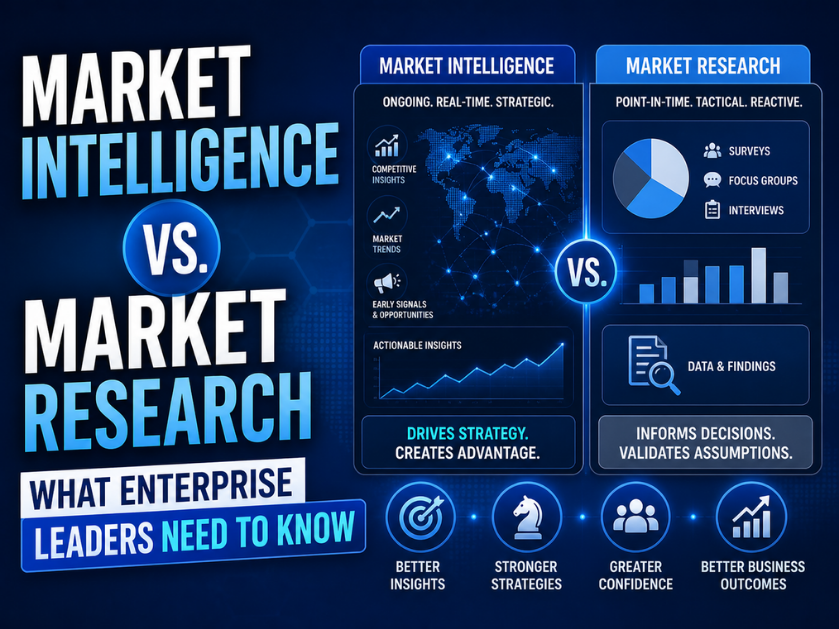
If you’ve ever sat in a strategy meeting and heard someone use market intelligence and market research interchangeably, you’re not alone. In enterprise organizations, the two terms get confused constantly, and that confusion has real consequences for how decisions get made.
Understanding the difference between market intelligence vs. market research isn’t just a matter of semantics. It’s a strategic distinction that affects how your insights function is structured, what questions you’re able to answer, and how confidently your leadership team can act on the intelligence you provide.
This guide breaks down both concepts clearly, explores how they complement each other, and explains why enterprise leaders need both to build a decision-grade intelligence function.
Market research is the structured process of collecting, analyzing, and interpreting data about a specific market, customer segment, or business question. It is typically project-based, initiated to answer a defined question, and concluded once findings are delivered.
Classic forms of market research include:
Market research is invaluable for grounding strategy in customer reality. When a bank wants to understand how customers feel about a new mobile feature before launching it, or a retailer needs to know which customer segments are most price sensitive. That’s market research at work.
|
Market research answers specific questions at a point in time. It’s deliberate, structured, and project-driven. Its strength is depth and precision. Its limitation is that it captures a snapshot, not a continuously evolving picture. |
Market intelligence is an ongoing, integrated capability that aggregates information from multiple sources to build a comprehensive, continuously updated view of the market environment. Rather than answering a single question, it monitors the competitive landscape, tracks emerging trends, surfaces early signals, and translates external dynamics into a strategic context for leadership.
Market intelligence draws from a broad range of inputs:
Where market research tells you what customers think about a specific product feature right now, market intelligence tells you how the competitive landscape is shifting, where customer needs are evolving, and what market forces could disrupt your business over the next 12 to 36 months.
|
Market intelligence is less about answering a single question and more about maintaining a living, strategic view of your environment. It’s the difference between a photograph and a live feed. |
The table below captures the key distinctions enterprise leaders should understand:
|
Factor |
Market Research |
Market Intelligence |
|
Scope |
Specific project or question |
Ongoing, continuous monitoring |
|
Time Horizon |
Point-in-time snapshot |
Dynamic, forward-looking |
|
Primary Focus |
Customer behavior & preferences |
Competitive landscape & market trends |
|
Data Sources |
Surveys, focus groups, interviews |
News, filings, competitor data, internal analytics |
|
Output |
Research report or findings |
Actionable strategic intelligence |
|
Decision Support |
Tactical and campaign decisions |
High-stakes executive decisions |
|
Cadence |
Project-based |
Continuous or recurring |
|
Owner |
Insights or research team |
Strategy, insights, or intelligence function |
Neither approach is superior to the other. They serve different purposes and different time horizons. The most sophisticated enterprise intelligence functions integrate both using market research to go deep on specific questions, and market intelligence to maintain strategic awareness across the broader environment.
The confusion between market intelligence and market research typically traces back to organizational structure. In many enterprises, both functions sit inside the same team often labeled “Consumer Insights” or “Market Research.” When one team owns both responsibilities, the distinction between them can blur.
There are also legacy reasons. For much of the 20th century, “market research” was the dominant term for understanding customers and markets. Intelligence capabilities as a distinct function are comparatively newer and, in many organizations, still maturing.
The consequence of conflating the two is significant. Organizations that think of intelligence purely as market research tend to:
Enterprise organizations that operate at the highest level of strategic clarity understand that research and intelligence, while related, require different infrastructure, cadence, and organizational positioning.
Think of market research as the deep dive and market intelligence as the wide scan. Both are essential. Used together, they create what we call decision-grade intelligence, the kind that enables leadership to act with confidence, not just awareness.
Intelligence capabilities continuously scan for changes in customer behavior, competitor moves, regulatory shifts, and market dynamics. When a signal emerges — say, a competitor announces a new pricing model or a regulatory change is looming — intelligence functions surface it quickly and connect it to existing strategy.
When a signal warrants a deeper look, market research steps in. Perhaps the intelligence function has flagged growing customer dissatisfaction in a specific segment. Market research then designs and executes the study needed to understand why, and to give leadership the granular evidence required to make a confident decision.
The most effective enterprise insight functions operate a continuous cycle:
This cycle is what separates organizations that react to their markets from those that shape them.
The line between market research and market intelligence is being further transformed by AI and advanced analytics. Today’s enterprise intelligence functions can leverage machine learning to automate signal detection, natural language processing to synthesize unstructured data at scale, and predictive modeling to move from describing what happened to anticipating what’s next.
AI does not replace the judgment required to turn information into strategy, but it dramatically accelerates and scales the intelligence gathering process. Organizations that modernize their intelligence infrastructure gain a material advantage: they surface insights faster, with greater coverage, and at a lower cost per insight.
This is particularly important for market intelligence, where the value lies in the speed and breadth of environmental scanning. AI-enabled intelligence systems can monitor thousands of inputs simultaneously, something no human team could manage manually.
|
For enterprise insight leaders, the question is no longer whether to adopt AI-enabled intelligence tools; it’s how to integrate them intelligently into existing research and analytics infrastructure without creating more fragmentation. |
If you’re responsible for customer insights, analytics, or strategy in an enterprise organization, the distinction between market intelligence and market research has direct implications for how you build, position, and fund your function.
Here’s what leading enterprise insight functions are doing differently:
The most forward-thinking insight leaders are moving their teams from a project-request model toward a proactive intelligence model, one that continuously generates strategic context for leadership rather than waiting to be asked.
Rather than managing research and intelligence as separate workstreams, leading organizations are building unified intelligence systems that connect internal data, external monitoring, and primary research into a single coherent view.
This means defining who is responsible for ongoing intelligence monitoring, how signals get surfaced to leadership, what triggers a research deep-dive, and how findings are synthesized back into the broader strategic picture.
Neither market research nor market intelligence creates value unless findings are translated into the strategic language executives actually use: risk, opportunity, timing, and confidence. The best insight functions have mastered this translation.
Use Market Research when you need to:
Use Market Intelligence when you need to:
Market intelligence and market research are both essential to building a world-class enterprise insight capability, but they are not the same thing, and treating them as such limits the strategic value your insights function can deliver.
Market research answers the deep questions. Market intelligence keeps you informed on the broad ones. Together, they form the foundation of a decision-grade intelligence system, one that enables enterprise leaders to move with clarity, confidence, and speed.
For organizations looking to make their most critical decisions with greater certainty, integrating both capabilities into a unified intelligence function is not optional. It’s the baseline for competing at the highest level.
|
At Mack Turner Marketing, we help enterprise organizations transform fragmented data, research, and analytics into integrated intelligence systems that enable faster, more confident strategic decisions. If you’re ready to explore what that looks like for your organization, let’s talk. |
Q1: Is market intelligence the same as competitive intelligence?
Not exactly. Competitive intelligence is a component of market intelligence. Market intelligence encompasses a broader view, including customers, trends, regulations, and industry dynamics, competitive intelligence focuses specifically on rivals.
Q2: Which should enterprise organizations invest in first?
If you’re building from scratch, start with market research to establish a foundational customer understanding. Then layer in market intelligence capabilities to keep those insights current and strategically relevant.
Q3: How often should market intelligence be updated?
For enterprise organizations, core intelligence dashboards should be refreshed continuously or at a minimum monthly. Deep-dive strategic intelligence reports are typically produced quarterly.
Q4: Can AI replace market research?
AI can automate data collection, pattern recognition, and early signal detection, but it cannot replace the human judgment needed to interpret findings in business context or design research that asks the right questions.
Q5: What team owns market intelligence in an enterprise?
Ownership varies. It may sit within strategy, customer insights, competitive intelligence, or a dedicated analytics function. The key is that one team owns the synthesis and delivery to leadership, fragmented ownership kills the value of any intelligence function.
More data does not guarantee better decisions. Learn why enterprise decision intelligence helps organizations create clarity, alignment, and strategic action.