

Enterprise Decision Intelligence: Why Organizations Need Coherence, Not More Data
More data does not guarantee better decisions. Learn why enterprise decision intelligence helps organizations create clarity, alignment, and strategic action.
Welcome to WordPress. This is your first post. Edit or delete it, then start writing!

May, 2026
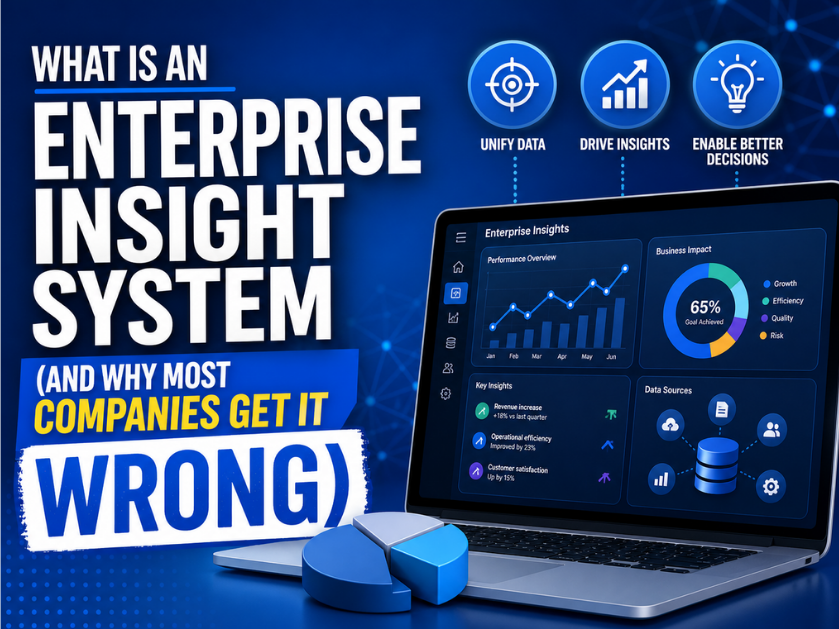
Most large organizations are not short on data. They have plenty of it. Customer surveys, behavioral analytics, CRM records, market research reports, competitive intelligence files, and more. The problem is that none of it talks to each other.
One team runs voice of customer research. Another manages digital analytics. A third oversees market intelligence. Each group has its own tools, its own reports, and its own version of what the customer looks like. When leadership needs a clear answer to a strategic question, they get three different answers from three different teams.
This is one of the most expensive and overlooked problems in enterprise organizations today. And it is exactly what an enterprise insight system is designed to fix.
An enterprise insight system is a structured approach to connecting all of your organization’s customer data, research, and analytics into one unified intelligence layer that leaders can actually use.
Think of it less like a single piece of software and more like an architecture. It brings together all your insight sources, research methodologies, data streams, and analytical capabilities into a connected system designed around one goal: helping the right people make the right decisions faster.
When done well, an enterprise insight system does three things that siloed tools simply cannot do on their own.
That shift from reactive to proactive is where the real value lives.
Here is the truth: most enterprise organizations know they have a data problem. Leaders feel it every time they walk into a strategic planning meeting and hear conflicting numbers from different teams. They feel it when a major decision gets delayed because no one can agree on what the customer actually wants.
But instead of addressing the root cause, most organizations try to solve it with more tools. More dashboards. More reports. More data vendors. That approach rarely works because the problem is not a shortage of information. The problem is a shortage of integration.
Every organization is different, but a well-built enterprise insight system generally includes these core elements.
This means connecting your various data sources, customer surveys, behavioral data, transactional data, market research, and competitive intelligence, into a shared environment where they can be analyzed together. The goal is not necessarily one giant database. It is a coherent architecture where data can flow across sources when needed.
One of the most underrated problems in enterprise organizations is that different teams use different definitions for the same things. What counts as a loyal customer? What qualifies as a market opportunity? Without shared definitions, even well-integrated data leads to confusion. A strong insight system establishes a common language across the enterprise.
Raw data and research reports are not insights. Insights are synthesized, interpreted, and connected to a specific business question. A proper enterprise insight system is designed to deliver intelligence in the format and cadence that supports actual decision making, not just data consumption.
The most mature enterprise insight systems do not just answer questions. They anticipate them. This involves building predictive models, tracking emerging signals in customer behavior and market dynamics, and surfacing intelligence before leaders have to ask for it.
Decision-grade intelligence is a term that describes information that is clear enough, confident enough, and well-organized enough to directly inform a major business decision. Most data and research does not meet this standard on its own.
To reach decision-grade quality, insight needs to be synthesized across multiple sources, contextualized within the relevant business question, and communicated in a way that removes ambiguity rather than adding to it.
When leaders have access to decision-grade intelligence, a few things tend to happen consistently.
Consider a large financial services organization navigating a major product launch. Without a unified insight system, the research team delivers a customer needs study, the analytics team delivers a behavioral data report, and the competitive intelligence team delivers a separate landscape analysis. Each report tells a different part of the story, but no one synthesizes them together before the leadership team meets to make the launch decision.
With a proper enterprise insight system in place, those three streams of intelligence are integrated and delivered as a single, synthesized briefing. Leadership can see how customer needs, actual behaviors, and the competitive environment all connect. The decision becomes clearer. The risk of missing something important drops significantly.
That is not a hypothetical. That is what well-structured insight architecture delivers in practice.
Not every organization has reached the scale where a formal enterprise insight system is necessary. But if you are recognizing any of these patterns, it may be time to address the architecture.
If two or more of these sound familiar, the issue is almost certainly structural, not a data shortage.
Building a full enterprise insight system takes time. But the process does not have to be overwhelming if you approach it in the right order.
Organizations that invest in genuine insight integration hold a meaningful edge over those that do not. They move faster. They make fewer costly mistakes. They understand their customers more deeply and more accurately than competitors who are still working from fragmented, siloed data.
More importantly, they build something that compounds over time. Every decision informed by a strong insight system adds to the organizational knowledge base. Every integration between data sources makes future analysis richer and more reliable.
In a competitive environment where the pace of market change keeps accelerating, the ability to turn data into clear, confident decisions is not just a nice thing to have. It is a genuine strategic asset.
An enterprise insight system is not a software purchase or a one-time project. It is a fundamental change in how your organization thinks about the relationship between data and decisions.
Most companies struggle with this not because they lack the data or the talent, but because they have never deliberately designed their insight architecture around the decisions that matter most. When they do, the results tend to be fast, significant, and lasting.
If your organization is ready to move from fragmented data to decision-grade intelligence, the starting point is simpler than most leaders expect. It begins with asking a single question: what decisions do we need to make, and what does leadership need to know in order to make them with confidence?
More data does not guarantee better decisions. Learn why enterprise decision intelligence helps organizations create clarity, alignment, and strategic action.